9 Dec 2025
Sanctions Screening Guide for Cross-Border B2B Marketplaces and SaaS Platforms
A practical sanctions screening guide for B2B marketplaces and SaaS platforms that move money or goods across borders, covering onboarding, ongoing monitoring and audit-ready evidence for banks, PSPs and enterprise customers.
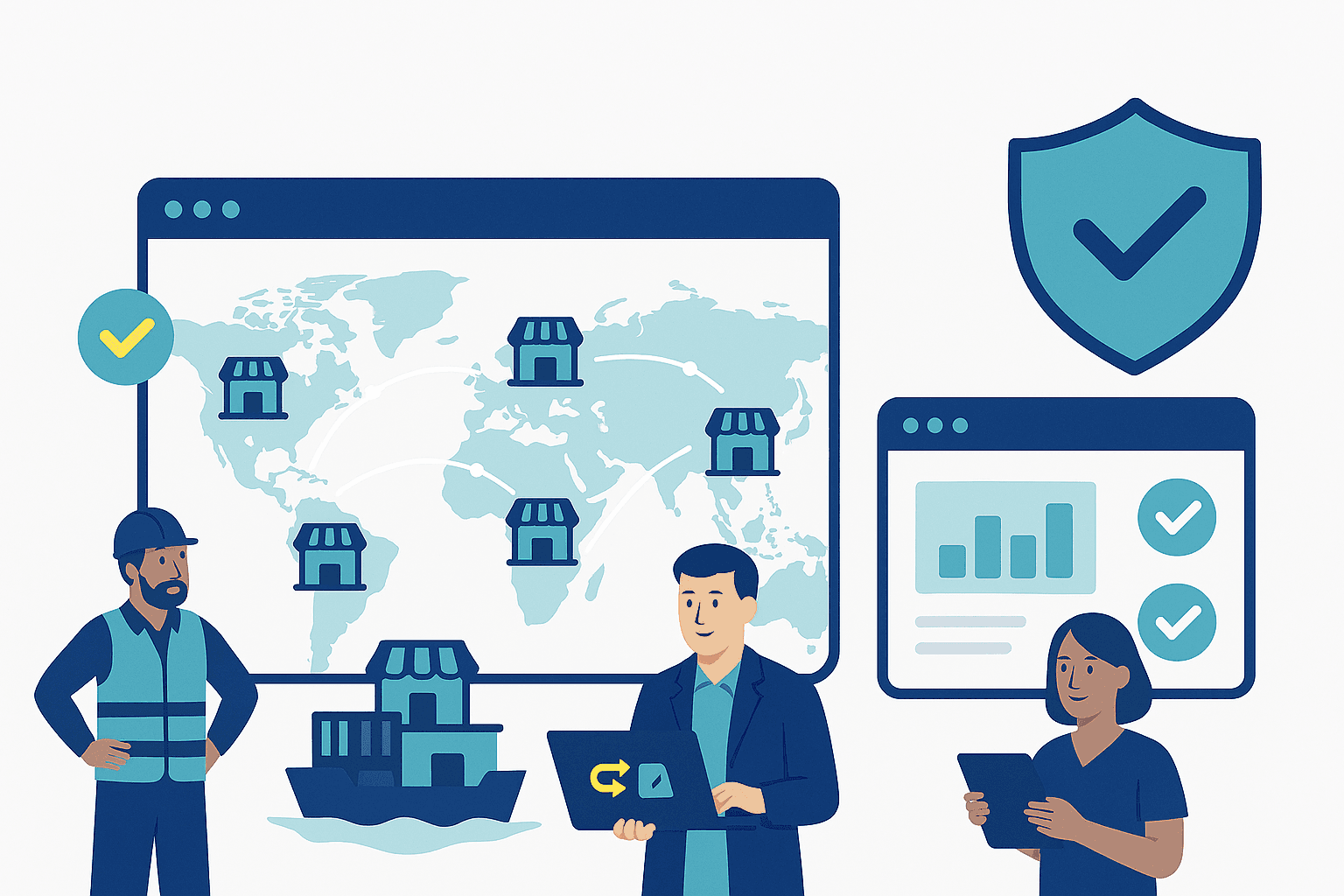
Sanctions screening guide for cross-border B2B marketplaces and SaaS platforms
Cross-border B2B marketplaces and SaaS platforms sit in an awkward middle ground:
- You move money or goods internationally
- You touch high-risk sectors (manufacturing, logistics, professional services)
- But you aren’t a bank – and you don’t have a 30-person compliance team
This guide gives product, ops and compliance leads a practical playbook for setting up sanctions screening that:
- Protects payment and payout flows
- Supports marketplace trust & safety
- Generates documented audit trails for partners and regulators
- Stays realistic for lean teams (1–3 people, not 50)
1. Why B2B marketplaces and SaaS platforms can’t ignore sanctions
If your platform lets businesses:
- Pay each other for goods or services
- Store balances (wallets, credits, virtual IBANs)
- Arrange cross-border shipments or projects
…then you’re exposed to sanctions risk, even if you don’t hold a banking licence.
Typical risk drivers:
- Cross-border flows: buyers in the EU paying sellers in higher-risk regions
- Complex supply chains: sub-suppliers or logistics partners hidden behind a primary vendor
- Multi-tenant structure: one platform, many merchants / tenants, each with different risk levels
- Payment partners’ expectations: acquirers, PSPs and banks increasingly require your own sanctions policy, not just theirs
What’s at stake:
- De-risking by your bank or PSP (account or MID closed with short notice)
- Scheme or marketplace suspension (cards, alternative payment methods, wallets)
- Contract loss with large enterprise customers who expect sanctions due diligence
- Reputational damage if a sanctioned seller, buyer or transaction is exposed in the press
2. Map your sanctions exposure by business model
Before buying tools or writing policy, map where sanctions risk actually lives in your product.
2.1 B2B goods marketplaces (equipment, wholesale, spare parts)
Risk hot spots:
- Sellers / vendors: especially resellers of dual-use goods or industrial equipment
- Beneficial owners (UBOs): sanctioned or high-risk individuals behind a trading company
- Shipping and logistics partners: last-mile carriers or freight forwarders in higher-risk regions
- End-use and end-user: goods routed to sanctioned countries or denied end-users
Sanctions controls usually focus on:
- Seller onboarding (KYB + ownership checks)
- Periodic re-screening of sellers and key counterparties
- High-risk deal review (e.g. exports involving specific HS codes or destinations)
2.2 B2B SaaS with global customer base
Think billing platforms, developer tooling, marketing platforms, HR or productivity tools:
Risk hot spots:
- Subscribers and account owners: companies or individuals based in or linked to sanctioned regions
- Resellers and partners: agencies or system integrators who manage multiple end-customers
- Billing entities: legal entity using the service vs. actual user locations
Sanctions controls often include:
- Screening billing entities and contracting parties at signup and renewal
- Screening admin users in high-risk regions
- Applying geo-controls on IP / payment methods for comprehensive and sectoral sanctions
2.3 Vertical SaaS or marketplaces in logistics, construction, energy or trade
Here the mix is more intense:
- You might onboard freight forwarders, brokers, customs agents, ports, warehouses
- You might interact with traders or intermediaries who are only partially transparent
- Deal sizes are larger and inspection / audit expectations are higher
Sanctions controls tend to combine:
- Name & ownership screening of counterparties
- Route / corridor rules (no shipments via X, no calls at Y ports)
- Enhanced record-keeping for investigations and customer due diligence packs
3. Designing a risk-based sanctions policy (not a bank-clone)
You don’t need to copy a global bank policy. You do need a policy that:
- Covers your real risks
- Can be executed by your current team
- Produces evidence you can share with partners
At a minimum, your policy should answer:
-
Who do we screen?
- Direct customers (buyers, sellers, subscribers, vendors)
- Key owners and controllers (UBOs, directors, signatories)
- Certain partners (logistics, resellers, escrow providers)
-
When do we screen?
- At onboarding or contract signing
- Before first payout or large transaction
- Periodically (e.g. weekly re-screening of active counterparties)
- On “events” (role change, ownership change, risk trigger)
-
What do we screen against?
- Core lists: UN, EU, OFAC, UK, plus local lists where you operate
- Optional: sector-specific or ownership/control rules (e.g. Russia, Iran)
-
How do we document decisions?
- Where do we store case notes, screenshots, PDF reports?
- How long do we keep data? (retention rules)
- Who can sign-off on overrides or escalations?
A simple, realistic policy you actually follow is more defensible than a 60-page policy nobody implements.
4. Building the sanctions screening journey in your product
Below is a pragmatic design that works for most B2B marketplaces and SaaS platforms.
4.1 Onboarding: company and key people
At signup, collect and screen:
- Legal entity name + registration details
- Country of incorporation and operation
- Key individuals: UBOs, directors, authorised signatories (where feasible)
Recommended steps:
- Run a full name check for entity + key individuals against your sanctions lists
- Capture results in an audit log entry linked to the account / tenant
- If there’s a potential hit:
- Flag the account with a “Compliance review” status
- Assign a reviewer and capture their decision (clear / escalate / reject)
- Store evidence (screenshots or PDFs of the screening results)
MatchAudit can automate:
- Screening via UI or API during onboarding
- Writing audit-ready logs and generating PDF reports that can be shared with partners
- Re-screening active customers on a schedule (e.g. weekly)
4.2 Ongoing monitoring: active tenants and high-value accounts
Instead of re-screening everyone every day, focus on:
- Active tenants (recent invoices, shipments, projects, logins)
- High-value accounts by revenue or volume
- Higher-risk corridors (e.g. exports to specific regions)
Practical pattern:
- Maintain an “active counterparties” list (ACM – Active Counterparties per Month)
- Push that list to your sanctions engine weekly for re-screening
- Only open cases when:
- There’s a new hit
- A match score increases substantially
- A customer moves into a higher-risk country or sector
This keeps alerts manageable for lean teams while staying defensible in reviews.
4.3 Payments, payouts and wallets
For platforms that move money:
- Screen payees / sellers before first payout
- Re-screen when bank accounts or payout details change
- Add rules like:
- Block payouts if a sanctions hit is pending
- Require a manual review if large payouts are going to higher-risk countries
Where possible, align with your PSP / acquiring bank:
- Share your sanctions policy and technical flow
- Show examples of MatchAudit PDF reports and audit logs
- Clarify who screens what (you vs. them) to avoid gaps or duplication
5. Reducing false positives without missing true risk
B2B platforms often struggle with:
- Common company names (e.g. “Global Trading”, “International Consulting”)
- Transliteration and spelling variations
- Very noisy results from generic tools
Key levers to improve precision:
5.1 Use more than just the name string
Improve matching by considering:
- Country of registration / operation
- Date or year of birth (for individuals)
- Industry or sector (construction vs. software vs. logistics)
Hit evaluation workflow:
- Check if country overlaps with the sanctions entry
- Check if date/year of birth is compatible
- Look at program / regime (Russia, terrorism, DPRK, etc.)
- Decide: clear as false positive, escalate, or block
5.2 Tune matching and use “explainable” scores
Look for screening that gives:
- A numeric confidence score
- A clear explanation: which fields matched and why
This is exactly what MatchAudit optimises for: explainable scores with human-readable reasons that you can paste into a case file or partner questionnaire.
6. Evidence, auditability and partner expectations
For B2B marketplaces and SaaS businesses, the “customer” is often:
- An enterprise buyer (procurement, risk, or compliance team)
- A PSP or bank underwriting your flows
- A card scheme or payment network
All of them care about evidence more than marketing slides.
You should be able to:
- Produce an export of screening activity (e.g. by date range, by counterparty)
- Show individual case histories: what was screened, what matched, who approved what
- Share PDF reports that stand up in a governance committee or regulatory inspection
MatchAudit helps by:
- Logging each search / API call with a timestamp, user/API key and parameters
- Storing match details and decisions per event
- Generating structured PDF reports that you can attach to RFP responses or partner reviews
7. Minimum viable sanctions program for B2B marketplaces & SaaS
If you’re starting from zero, a realistic MVP looks like this:
Policy
- 4–6 pages covering:
- Scope (who you screen, when, and against which lists)
- Governance (who approves policy and high-risk decisions)
- Escalation paths (who you talk to when there’s a real hit)
- Record-keeping and retention
Controls
- Onboarding screening for new customers, vendors or tenants
- Weekly re-screening of active counterparties
- Pre-payout checks for higher-risk markets
- Manual review workflow for hits
Evidence
- Centralised audit log of all screenings
- Standard decision templates (“Why this match?” and “Why this is a false positive”)
- Exportable reports for banks, PSPs and large customers
8. How MatchAudit supports B2B marketplaces and SaaS platforms
MatchAudit is built specifically for non-bank institutions that need structured screening evidence:
- One dashboard + API for sanctions checks across UN, EU, OFAC, UK and more
- Name-matching tuned for business names and people with clear, human-readable explanations
- PDFs and exports you can attach to RFPs, bank reviews and scheme audits
- Re-screening support (CSV, async jobs and scheduled runs) so you can keep active counterparties up to date
Whether you run a B2B marketplace, billing platform or vertical SaaS, you can start with a lean, realistic sanctions program and grow into more automation as volumes and expectations increase.
Related reading
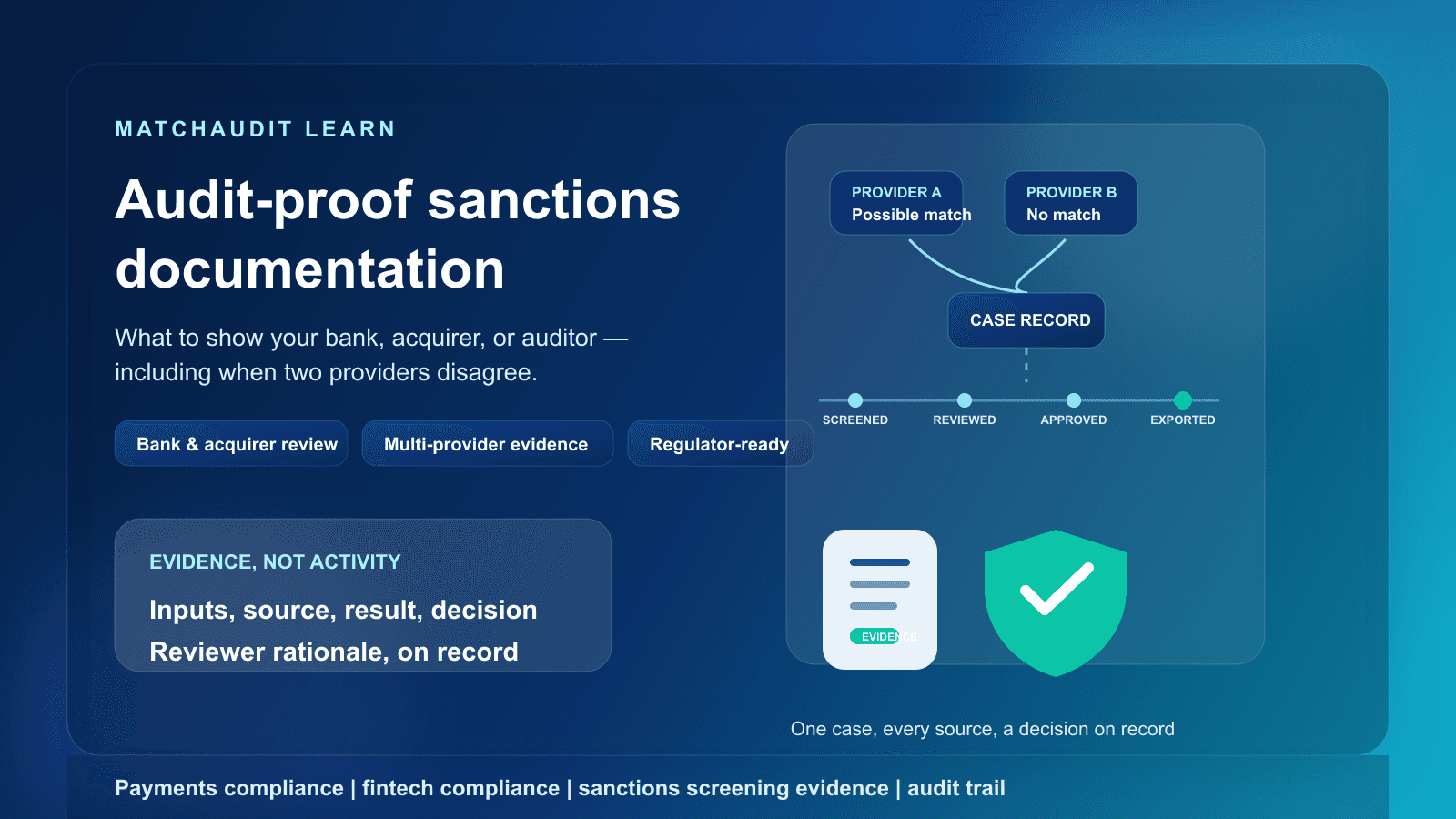
Audit-Proof Sanctions Documentation: What to Show Your Bank, Acquirer, or Auditor
A step-by-step guide to what a sanctions screening evidence pack needs to survive a bank, acquirer, or regulator request — including a worked example, how to document a decision when two screening providers disagree, and what OFAC, Wolfsberg, the FFIEC, the EBA and the FCA actually expect.
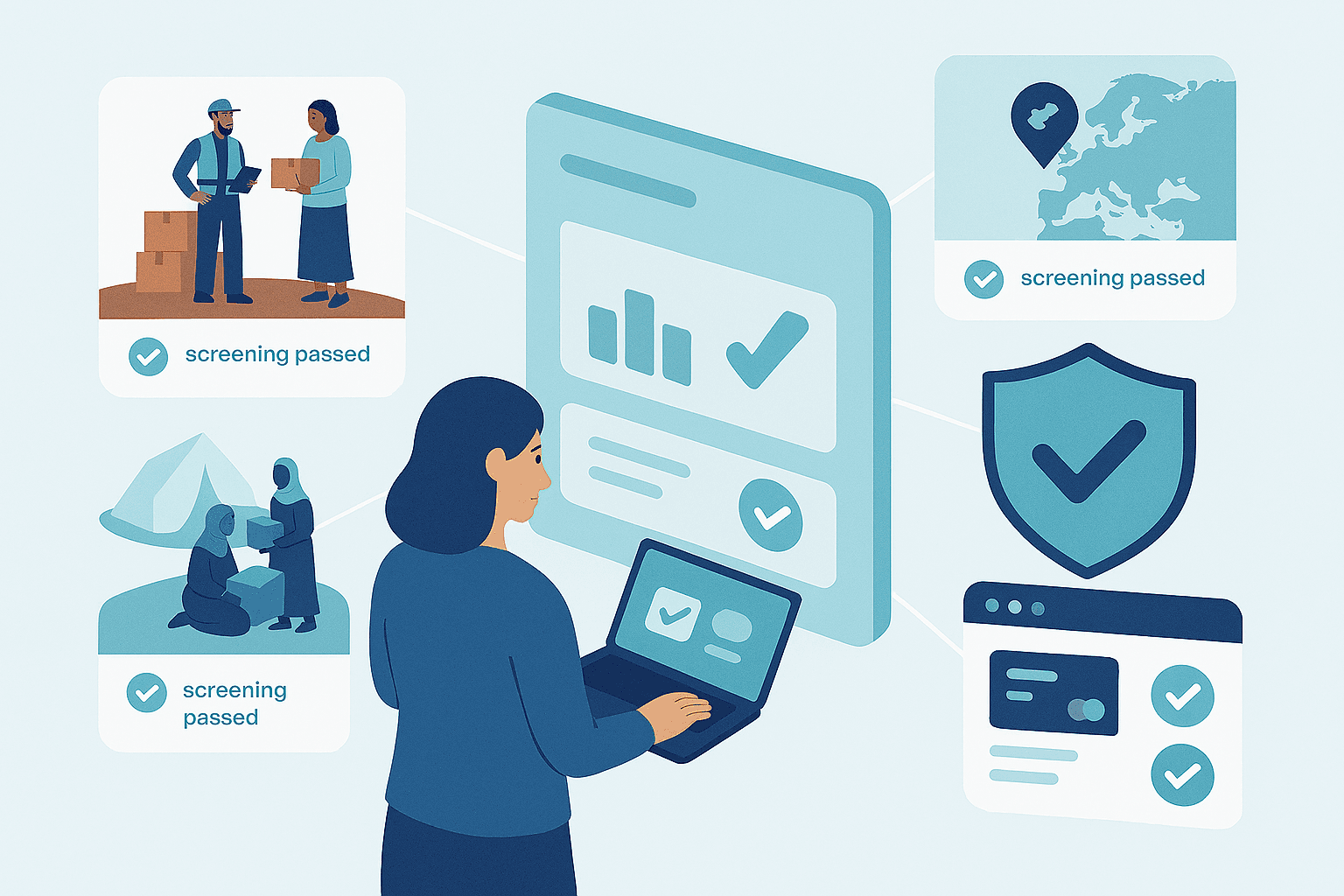
Sanctions screening guide for NGOs and humanitarian organisations
A practical sanctions screening framework for NGOs and humanitarian organisations that need to keep aid flowing, satisfy banks and donors, and produce evidence-grade reporting without a bank-sized compliance team.