9 Dec 2025
Sanctions screening guide for NGOs and humanitarian organisations
A practical sanctions screening framework for NGOs and humanitarian organisations that need to keep aid flowing, satisfy banks and donors, and produce evidence-grade reporting without a bank-sized compliance team.
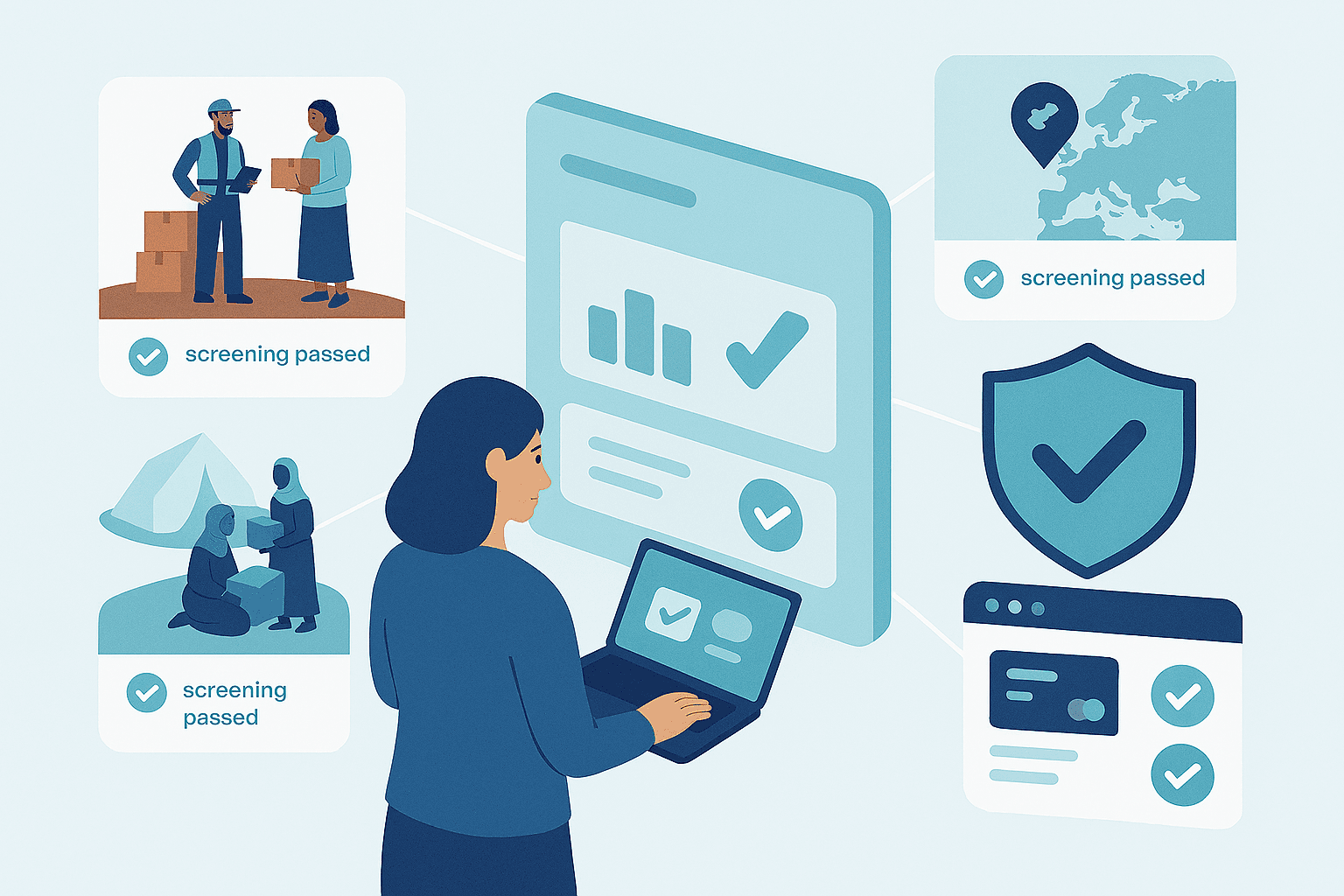
Sanctions screening guide for NGOs and humanitarian organisations
Non-governmental organisations (NGOs) and humanitarian operators sit in one of the toughest positions in sanctions compliance:
- You often work in or near sanctioned regions
- You move funds, goods and people through fragile corridors
- You depend on banks, PSPs and donors who expect strong controls
- But you rarely have the budget or headcount of a bank
This guide gives compliance, finance and field operations teams a practical sanctions screening framework designed for NGOs and humanitarian organisations that:
- Need to keep aid flowing without breaching sanctions
- Must satisfy bank, PSP and donor expectations
- Operate with small central teams spread across countries
1. Why sanctions compliance matters so much for NGOs
NGOs and humanitarian organisations are not “too small to matter” in sanctions enforcement. In reality, you’re right on the front line.
You face three overlapping pressures:
1.1 Legal and regulatory exposure
- Financial sanctions, counter-terrorism and proliferation rules can apply to:
- Grants, sub-grants and vendor payments
- Cash assistance programmes and prepaid cards
- Material support (vehicles, medical equipment, ICT gear)
- Directors, trustees and senior managers may face personal exposure if controls are clearly inadequate.
1.2 Bank and PSP de-risking
Banks and payment providers are under pressure not to facilitate flows that look like sanctions evasion or terrorism financing.
- Weak screening or poor documentation can lead to:
- Payment blocks, multi-week reviews or frozen transfers
- Requests for “enhanced due diligence” you can’t easily evidence
- In extreme cases: account closures or rejected onboarding
1.3 Donor, UN and multilateral expectations
Institutional donors, UN agencies and development banks increasingly expect NGOs to:
- Screen partners, suppliers, board members and key staff
- Show an audit trail of how sanctions checks were run
- Provide documented reports that can be shared with:
- Donor audit teams
- Internal audit / risk committees
- Local regulators or FIUs where required
In other words: your sanctions framework isn’t just “legal hygiene” — it’s core to being bankable, fundable and operational.
2. Where sanctions risk lives in an NGO operating model
Before designing controls, map the areas where sanctions risk actually appears in your operations.
2.1 Partners and implementing organisations
Examples:
- Local NGOs and community-based organisations (CBOs)
- Faith-based groups and informal networks
- Local UN-implementing partners or consortia members
Risks:
- A local partner, founder or key signatory appears on UN, EU, OFAC or UK lists
- Ownership or control links to a sanctioned individual, entity or political group
- A partner is a front for a designated organisation, even if its local name looks benign
2.2 Vendors and suppliers
Examples:
- Logistics firms, customs brokers, warehousing providers
- Construction companies and local procurement vendors
- Cash distribution agents, fintech partners, mobile money operators
Risks:
- Vendor beneficial owners are sanctioned or closely associated with sanctioned actors
- The vendor is used to move goods into embargoed territories
- You unintentionally fund state-owned or military-linked companies in high-risk jurisdictions
2.3 Staff, volunteers and governance roles
Examples:
- Senior field leadership, trustees and board members
- Local signatories on bank accounts and key contracts
- High-risk roles (procurement, cash programming, security)
Risks:
- A key decision-maker is on a terrorism or sanctions list
- Political exposure (PEP) intersects with local corruption or conflict dynamics
2.4 Beneficiaries and programme participants
Not every NGO screens beneficiaries at a name-by-name level — that’s often disproportionate and can be operationally impossible. But you should:
- Understand where screening is expected (e.g. cash-based interventions with high values)
- Apply targeted screening when beneficiaries:
- Receive significant financial support
- Are linked to higher-risk groups (e.g. political cadres, militias)
- Act as intermediaries or “group leaders” in distribution networks
3. A pragmatic, risk-based sanctions framework for NGOs
You don’t need a bank-level team to build credible sanctions controls. You need a simple, risk-based framework that you can explain and defend.
Below is a practical structure you can adapt.
3.1 Define your sanctions policy and risk appetite
Start by writing down — in plain language — what your organisation will do.
Include:
- Scope: which counterparties you will screen:
- All implementing partners and vendors
- Board members, trustees and senior staff
- High-value or higher-risk beneficiaries (where feasible and proportionate)
- Lists: at minimum, consider:
- UN consolidated sanctions list
- EU, UK and OFAC lists if you:
- Receive EU/US/UK funding
- Work with European or international banks and PSPs
- Frequency:
- Onboarding screening for partners, vendors and key staff
- Re-screening cadence: e.g. monthly or quarterly for active partners
- Decisioning:
- Clear rules for “no go”, “needs further review” and “OK to proceed with mitigants”
If you use a tool like MatchAudit, your policy can reference one central screening platform where all checks and audit logs live.
3.2 Build a simple, layered screening workflow
For most NGOs, a three-layer approach is effective:
-
Baseline screening
- Screen all new partners, vendors and board members against UN + your relevant regional lists.
- Run checks before:
- Signing agreements
- Opening bank/PSP accounts
- Approving first payments
-
Ongoing monitoring for active partners
- Re-screen active partners and key vendors on a fixed cadence (e.g. monthly or quarterly).
- Re-screen before high-value disbursements or renewals.
-
Event-driven checks
- New media allegations or local intelligence
- Changes in local political control or conflict dynamics
- Donor-driven requests for deeper checks
With MatchAudit, you can combine:
- Single-name checks when onboarding a specific partner director
- CSV uploads for batch screening of vendor or partner lists
- An audit trail that proves what was screened and when
3.3 Standardise the data you collect
To avoid messy data and false positives, standardise your input:
For organisations:
- Legal name + local trade name
- Country of registration and registration number (if available)
- Known abbreviations and former names
- Key owners (shareholders) and controllers (board, trustees)
For individuals:
- Full name (as in passport/ID if possible)
- Date of birth and nationality (or best available approximation)
- Role (e.g. director, trustee, legal representative)
- Connection to the organisation (employee, volunteer, contractor)
The more structured your data, the easier it is to:
- Run clean matches
- Explain why a hit was or was not considered relevant
- Reduce dependence on “gut feel” exceptions
4. Handling alerts and false positives in low-capacity teams
NGOs and humanitarian organisations can’t afford to drown in noisy alerts. You need alert handling that is:
- Fast enough to avoid blocking urgent aid
- Defensible enough for auditors, donors and banks
4.1 Triage model for sanctions alerts
When a screening tool returns a potential match:
-
First-line triage (programme or finance team)
- Check for obvious mismatches:
- Completely different country / region
- Age or gender clearly inconsistent
- Different spelling that is not plausible in the local context
- Document why it’s clearly not the same person/entity.
- Check for obvious mismatches:
-
Second-line review (central compliance or risk focal point)
- Look at:
- Known aliases, former names and local spellings
- Date and place of birth, nationality, role
- Links to specific regimes or armed groups
- Decide:
- True match → escalate to senior leadership / board
- False positive → document rationale and proceed
- Unclear → pause, collect more information, consult donor or bank
- Look at:
-
Escalation and governance
- Keep a small sanctions review committee (could be 2–3 people in small NGOs).
- For true matches, you may need to:
- Terminate the relationship
- Inform donors or banks
- Take local legal advice
MatchAudit can help by:
- Showing why a match occurred (e.g. matched on alias, birthdate, list)
- Structuring the output so non-specialists can understand it
- Generating PDF reports you can attach to donor files or internal approvals
4.2 Reducing false positives without lowering standards
To stay efficient:
- Use a tool that can handle fuzzy names and transliteration, but still let you:
- Adjust thresholds where appropriate
- Show exactly which field matched (name, alias, DoB, etc.)
- Maintain a simple “whitelist with evidence” for:
- Entities you’ve thoroughly reviewed and cleared
- Recurring false positives with robust documentation
Important: a whitelist is not a “free pass” — it’s a way to avoid re-investigating the same false positive without relaxing your underlying policy.
5. Integrating sanctions checks into NGO payment flows
To support your 120M-exit-type clients (banks, PSPs and embedded fintech rails) and your own operations, sanctions screening needs to plug into payment flows cleanly.
5.1 When to screen in the payment lifecycle
For NGOs using European banks, local PSPs or cross-border fintechs, there are three useful integration points:
-
Pre-onboarding
- Screen counterparties before asking a bank or PSP to onboard you or your partners.
- Provide evidence reports proactively in KYC packs.
-
Payment initiation
- Screen payees during payment file creation (e.g. bulk SEPA, SWIFT, mobile money).
- Use batch uploads or API-based checks to catch issues before the bank does.
-
Periodic portfolio reviews
- Re-screen all active partners and key vendors at set intervals
- Align your cadence with donor reporting cycles and board risk reviews
5.2 How MatchAudit fits into NGO + PSP ecosystems
MatchAudit is designed for the non-bank ecosystem around NGOs:
-
NGOs & humanitarian operators
- Run sanctions checks from a simple web dashboard
- Export audit-ready PDFs for donor files, board packs and bank KYC
-
Payment service providers, BaaS platforms and cross-border fintechs
- Use MatchAudit as an API-first sanctions engine behind NGO flows
- Share consistent evidence back to NGO clients and corridor partners
This alignment means that your NGO sanctions framework isn’t just a cost centre — it becomes a bridge between you, your PSPs and your donors.
6. Templates you can adapt for your organisation
Below are lightweight patterns you can adapt into your own SOPs.
6.1 Suggested screening policy paragraph (example)
“<Organisation Name> will screen all new implementing partners, key vendors (above <x> EUR per year) and board members against UN and relevant regional sanctions lists (including EU, UK and OFAC, where applicable), prior to engagement. Active partners will be re-screened at least <monthly/quarterly>. Screening results and decisions will be documented in an evidence register and retained for a minimum of <x> years.”
6.2 Minimal sanctions decision log (spreadsheet fields)
- Counterparty name
- Type (partner / vendor / staff / beneficiary group)
- Country
- Screening date
- Lists used
- Result (no hit / false positive / true match)
- Decision owner
- Evidence link (MatchAudit report ID or PDF)
- Next review date
With MatchAudit, you can replace most manual logging by:
- Using the built-in audit trail for every screening
- Exporting PDFs or dataset views when donors, PSPs or banks ask for proof
7. Getting started in 7 days
Here’s a pragmatic way to move from “no structure” to a credible sanctions framework in one week:
-
Day 1–2 – Map exposure
- List your main partner types, vendor types and high-risk programmes
- Decide what you will and won’t screen (risk-based)
-
Day 3 – Draft policy
- Write a 2–3 page sanctions and screening policy
- Align with donor expectations and your banking partners
-
Day 4 – Set up tooling
- Create a MatchAudit account
- Run test screenings for:
- Your top 20 partners
- Key vendors
- Board and senior staff
-
Day 5–6 – Train focal points
- Train finance, grants and programme focal points to:
- Trigger screenings in MatchAudit
- Read and interpret results
- Store PDFs in the right project folders
- Train finance, grants and programme focal points to:
-
Day 7 – Finalise governance
- Formalise your sanctions review committee
- Add sanctions checks into:
- New partner/vendor onboarding
- High-value grant approvals
- Periodic portfolio reviews
Done right, you’ll be able to show banks, PSPs and donors that:
- You screen against relevant sanctions lists
- You have documented decisions and escalation paths
- You can produce documented reports on demand
And you’ll do it without needing a 20-person compliance department.
8. How MatchAudit can help NGOs and humanitarian organisations
MatchAudit is built for the non-bank ecosystem — including NGOs, PSPs, freight and marketplace operators that sit between donors and beneficiaries.
For NGOs and humanitarian organisations, this means you get:
-
Simple dashboard for non-specialists
- Single-name and CSV batch screening
- Clear explanations of why a hit occurred
-
Evidence-ready reporting
- PDF reports aligned with audit and donor expectations
- Dataset exports and hashes for when banks or PSPs need proof
-
Scalable when you grow
- Start with the free or SMB plans for a small central team
- Upgrade to API-based, high-volume plans as you embed MatchAudit into:
- Payment platforms
- BaaS partners
- Regional shared-service centres
This way, your sanctions framework supports not only mission-critical aid delivery, but also the infrastructure players (banks, PSPs, fintechs) who help move your funds across borders — exactly the ecosystem MatchAudit is built to serve.
Related reading
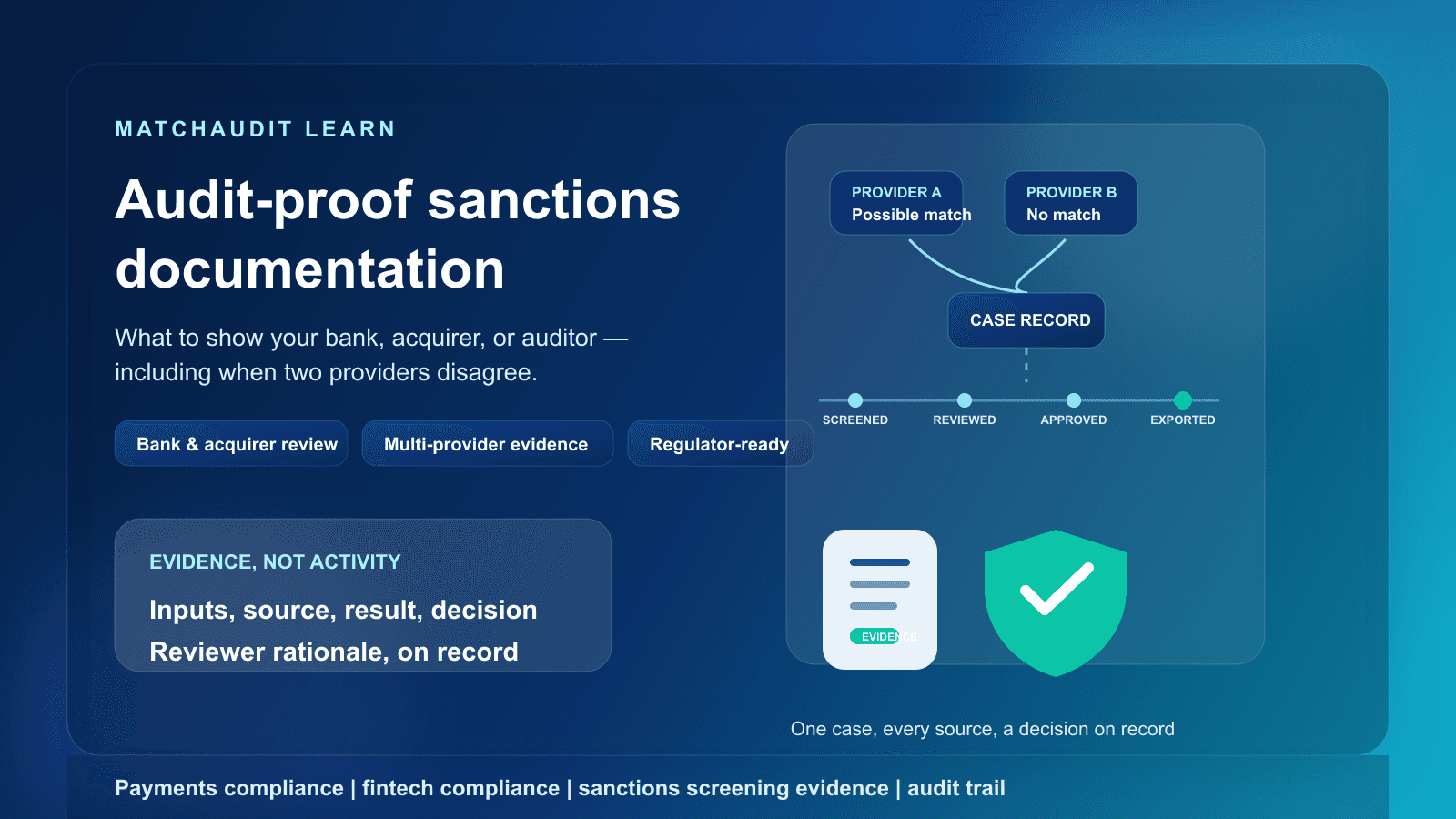
Audit-Proof Sanctions Documentation: What to Show Your Bank, Acquirer, or Auditor
A step-by-step guide to what a sanctions screening evidence pack needs to survive a bank, acquirer, or regulator request — including a worked example, how to document a decision when two screening providers disagree, and what OFAC, Wolfsberg, the FFIEC, the EBA and the FCA actually expect.
Sanctions Screening Guide for Cross-Border B2B Marketplaces and SaaS Platforms
A practical sanctions screening guide for B2B marketplaces and SaaS platforms that move money or goods across borders, covering onboarding, ongoing monitoring and audit-ready evidence for banks, PSPs and enterprise customers.