5 Jan 2026
Module 4 — Your Role (Stop, Escalate, Document)
Clear employee responsibilities, escalation triggers, and a simple escalation template.
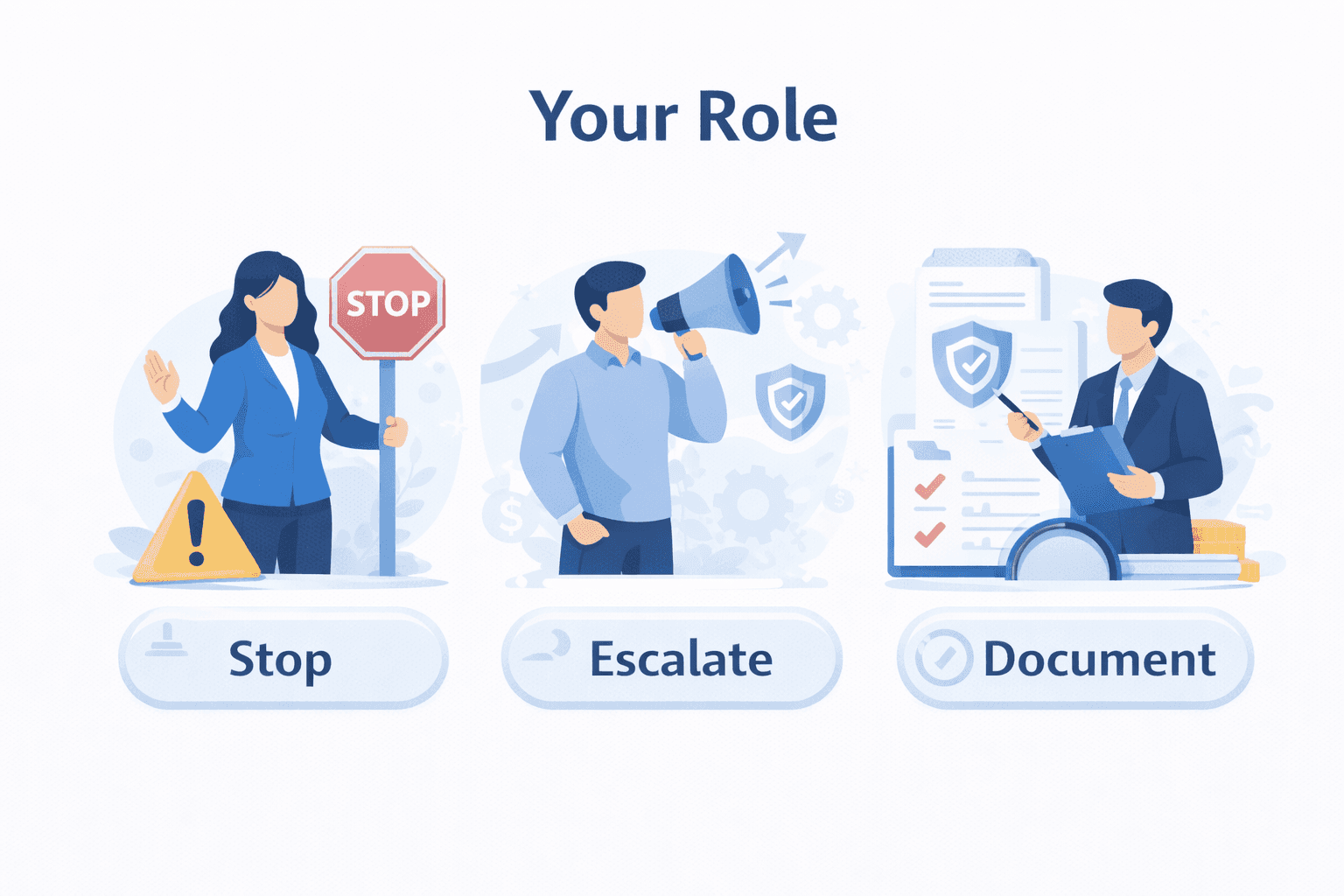
Module 4 — Your Role in Mitigating Sanctions Risk (Stop, Escalate, Document)
Goal of this module
After this module, you should be able to:
- Apply the Stop–Escalate–Document discipline consistently and confidently.
- Recognize the most common sanctions risk signals in payments and marketplaces.
- Escalate effectively by providing the right evidence the first time.
- Document actions in a way that is defensible in audits and regulatory reviews.
The rule that protects the company: Stop → Escalate → Document
When a sanctions risk signal appears, employees should follow one simple operational rule:
- STOP the relevant activity (hold/pausing actions as required by your process).
- ESCALATE to the right internal channel with a complete evidence pack.
- DOCUMENT what happened and what you did, in the system of record.
This rule prevents:
- prohibited funds movement,
- accidental provision of services/value to a sanctioned party,
- inconsistent handling across teams,
- weak audit trails that create regulatory exposure.
1) STOP: What “stop” means in practice
“Stop” does not mean panic. It means controlled containment.
What you should stop (common examples)
Depending on your role and systems, “stop” may include:
- Onboarding: pause verification/approval, do not activate accounts.
- Transactions: place a hold, do not release payments/payouts/refunds.
- Account actions: pause withdrawals, card issuance, limit increases (per internal rules).
- Marketplace actions: pause seller payouts, disable listings, stop fulfillment to restricted destinations (per internal rules).
- Support actions: do not advise workarounds (e.g., “try a different bank account”).
What “stop” is trying to prevent
- funds leaving your control before review,
- creation of value (services, payouts, refunds, credits) for a designated party,
- evidence loss (logs overwritten, cases closed prematurely).
What you must not do
- Do not “test” by splitting payments or retrying through other rails.
- Do not suggest customers “use a different name,” “try another account,” or “ship elsewhere.”
- Do not close the alert because it “looks unlikely” unless you are the authorized decision-maker.
- Do not communicate definitive outcomes to customers unless approved by Compliance.
Operational standard: If your process says “hold,” you hold. If unsure, you stop and escalate.
2) ESCALATE: How to escalate in a way that resolves the case fast
Escalation is not forwarding a screenshot. It is delivering a complete decision-ready package.
Who you escalate to (typical patterns)
Your company will define channels such as:
- Sanctions/Compliance queue in a case management tool,
- a dedicated Slack/Teams channel with structured intake,
- an on-call compliance rota,
- a ticketing category with required fields.
If multiple options exist, use the one that:
- creates a tracked case,
- ensures time-stamped ownership,
- preserves an audit trail.
Escalation priority levels (common operational approach)
Not all alerts are equal. A practical model:
-
P1 — Potential true hit / strong indicators
- high similarity match plus matching DOB/nationality/address
- obvious geographic restriction issue (restricted destination/region)
- ownership/control link indicators
- Action: immediate stop + immediate escalation
-
P2 — Possible match / limited identifiers
- common names, partial matches, limited data
- inconsistent but not definitive geography signals
- Action: stop + escalate with enrichment request
-
P3 — Likely false positive
- low similarity, clear mismatch on DOB/address/country
- Action: follow local procedure (often still document and route if required)
Important: Employees should not downgrade severity informally. Follow the predefined process.
The “first-time-right” evidence pack (what Compliance needs)
Provide the following whenever available. Missing items should be explicitly stated as “not available.”
A. Alert summary (what triggered the stop)
- product/system that generated the alert (onboarding screen, transaction screen, rule trigger)
- matched list/source (EU, OFAC, UN, UK, etc.)
- match details (matched name, match score/confidence, matched fields)
B. Party information (who is involved)
For individuals:
- full name + aliases
- DOB/place of birth
- nationality/residence
- address
- ID document details (if collected)
For entities:
- legal name + trading names
- registration number + country of incorporation
- directors/signatories
- UBOs and ownership structure (if available)
- website/business activity summary (if relevant)
C. Transaction context (what is happening)
- amount, currency, timestamp
- payer/payee roles and identifiers
- corridor (origin/destination countries)
- beneficiary bank and intermediary details (if available)
- purpose/description (free text, invoice, MCC, SKU/category)
D. Geography and delivery signals (where it is happening)
- billing country, shipping country/region
- IP/device geolocation signal (if you use it)
- fulfillment/warehouse location (marketplaces)
- evidence of rerouting/transshipment attempts
E. Actions taken so far (what you did)
- hold applied? account frozen? payout paused?
- which system actions were triggered
- whether customer communication occurred (and what was said)
Employee takeaway: The better the evidence pack, the faster the decision and the lower the operational disruption.
3) DOCUMENT: What “good documentation” looks like
Documentation is not bureaucracy. It is protection.
Why documentation matters
Sanctions decisions are reviewed by:
- internal audit,
- regulators,
- correspondent banks / scheme partners,
- your own legal team during incidents.
Poor documentation creates three risks:
- decisions appear arbitrary or inconsistent,
- you cannot prove controls operated,
- you cannot reconstruct events during an investigation.
What to document (minimum standard)
In the system of record, document:
- what triggered the stop (screening alert / rule)
- what you stopped (which action/transaction/account)
- when you stopped it (timestamps)
- what you escalated and to whom (case reference)
- what data/evidence you provided
- what decision was made (clear / reject / block / other)
- who approved the decision
- what follow-up actions occurred (release, lookback, tuning)
Documentation language: clear, factual, audit-ready
Write notes like you are explaining to someone who was not there:
- avoid opinions (“looks fine”)
- avoid slang (“seems sketchy”)
- use structured facts (“DOB mismatch; address differs; match is alias only”)
Common sanctions risk signals employees should recognize
A. Screening signals (list-based)
- match on full name + DOB/nationality
- multiple aliases that align
- match on address or passport/national ID
- entity match + UBO/principal match
B. Geography signals (country/region sanctions)
- shipping destination is restricted region
- bank account country inconsistent with stated operations
- customer tries repeated routing changes to avoid geo controls
- IP/device signals conflict with declared location (supporting signal)
C. Behavior signals (evasion patterns)
- repeated failed payments then success through different rails
- sudden changes to beneficiary details before payout
- multiple accounts with similar identifiers
- requests for “workarounds” from support (“Can we pay to another country?”)
Rule: You do not investigate like law enforcement. You capture signals, stop, escalate, and document.
Practical scenarios (what you should do)
Scenario 1 — Onboarding: seller looks clean but UBO is flagged
A marketplace seller’s company name screens clean. During KYB, an ultimate beneficial owner (UBO) returns a close match to a designated individual.
Do
- Stop onboarding activation.
- Escalate with the UBO details, ownership percentage, company registry info, and screening output.
- Document what checks were run and what was held.
Don’t
- approve the seller “because the company is not listed.”
- ask the seller to “use another person as UBO.”
Scenario 2 — Payout: beneficiary name triggers a close match
A payout is scheduled. Beneficiary name generates a close match on a sanctions list, but you only have name + country.
Do
- Stop the payout (hold).
- Escalate and request enrichment: DOB, address, ID, bank details, relationship to account holder.
- Document the hold and evidence gap.
Don’t
- release the payout to “avoid delays.”
- retry via a different bank rail.
Scenario 3 — Shipping: order to a restricted region
A marketplace order is placed for delivery to a restricted region. Buyer and seller are not listed.
Do
- Stop fulfillment/shipping and associated payment release.
- Escalate with order details, destination, product category, and any rerouting attempts.
- Document the policy trigger (geo restriction).
Don’t
- ship to an alternative address suggested by the customer without review.
- assume “no listed party” means “allowed.”
Scenario 4 — Support: customer requests workaround
A customer contacts support: “My payments keep failing. Can I send from another account under my relative’s name?”
Do
- Stop and escalate as potential evasion attempt.
- Document the request verbatim (as a risk signal).
- Follow approved communication scripts.
Don’t
- advise how to bypass controls.
- suggest “try another spelling” or “use a different beneficiary.”
What you can safely say to customers (approved-style language)
Use neutral, non-accusatory language. Examples:
- “Your transaction is under compliance review. We will update you as soon as possible.”
- “We are unable to process this request at this time due to regulatory requirements.”
- “Please provide the requested documentation so we can complete the review.”
Avoid:
- “You are sanctioned.”
- “We matched you to a watchlist” (unless your policy allows this disclosure).
- “Try a different bank/name.”
Quick checklist: Stop–Escalate–Document
Use this checklist whenever you see a potential sanctions issue:
STOP
- Hold/pause onboarding, transaction, payout, refund, or shipment (as relevant)
- Prevent retries/workarounds
- Preserve logs/evidence
ESCALATE
- Create a case in the right channel
- Include screening outputs + match details
- Include party identifiers + transaction context + geography signals
- State what is missing and what you need
DOCUMENT
- Time-stamped actions taken
- Data reviewed and provided
- Decision owner and outcome once available
- Follow-up actions (release/block/lookback/tuning)
Knowledge check (5 questions)
- If a sanctions alert seems unlikely, employees should ignore it to keep customer experience smooth. True or false?
- “Stop” typically means applying a hold/pause while review is ongoing. True or false?
- A good escalation includes transaction context and identifiers, not only a screenshot of a name match. True or false?
- Documentation should capture actions, timestamps, decision owners, and rationale. True or false?
- Advising customers on ways to bypass controls is acceptable if it helps complete the transaction. True or false?
Answers
- False. You must follow Stop–Escalate–Document consistently.
- True. Stop means contain risk while a decision is made.
- True. Compliance needs identifiers and context to resolve efficiently.
- True. Strong records reduce regulatory and legal exposure.
- False. Workarounds can be sanctions evasion and create serious risk.
Next, learn practical alert triage: how to distinguish likely false positives from potential true hits using identifiers and context.
Related reading
Module 6 — Checklists and Templates (Audit-Ready)
Print-ready employee checklists: daily safety checklist, escalation template, and evidence pack checklist.
Module 5 — Industry Scenarios (PSP, Marketplace, Fintech/Crypto, Freight Forwarder)
Practical scenarios with red flags, correct actions, and evidence pack requirements for high-risk industries.