5 Jan 2026
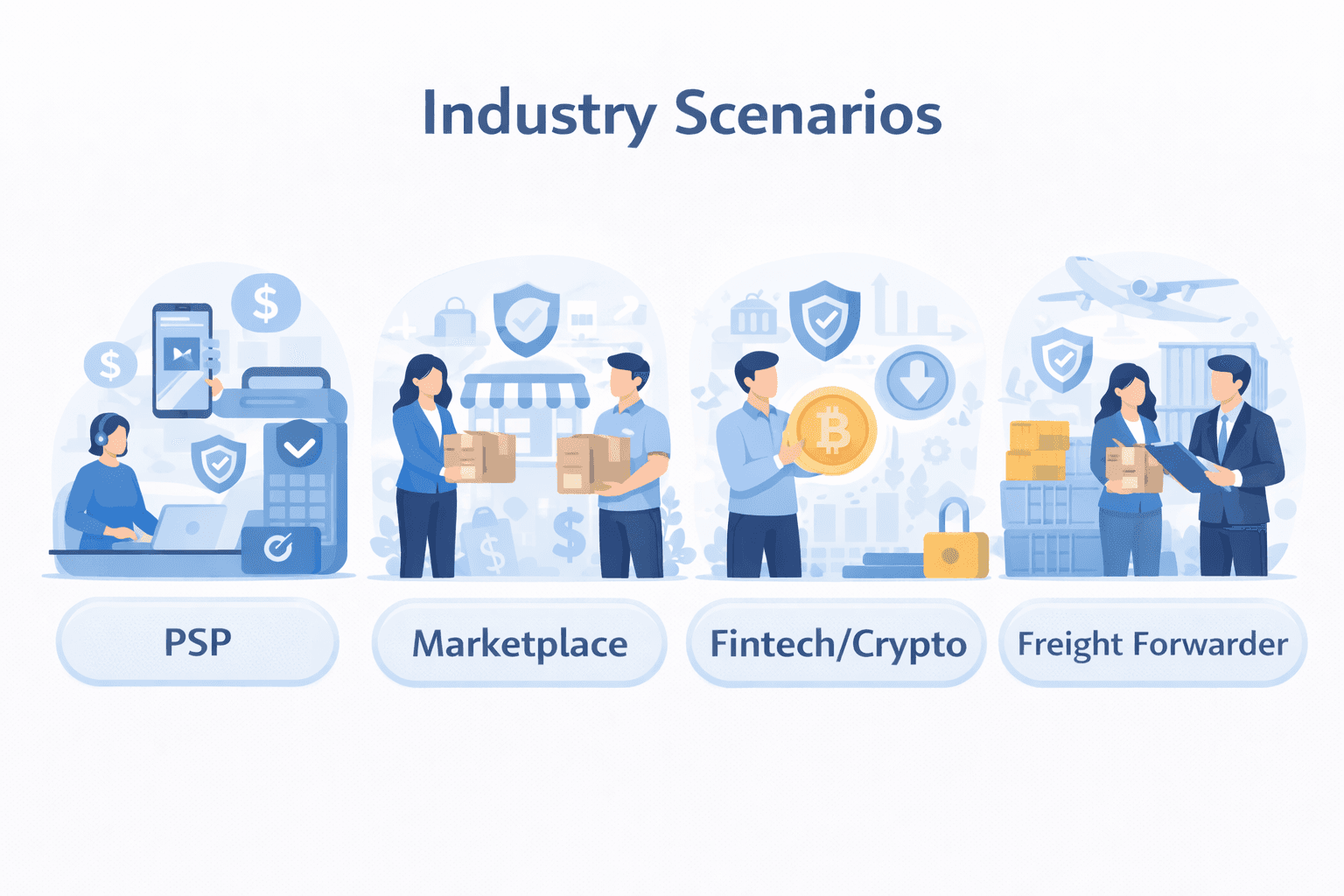
Module 5 — Industry Scenarios (PSP, Marketplace, Fintech/Crypto, Freight Forwarder)
Practical scenarios with red flags, correct actions, and evidence pack requirements for high-risk industries.
Module 5 — Industry Scenarios (PSP, Marketplace, Fintech/Crypto, Freight Forwarder)
Goal of this module
After this module, you should be able to:
- Recognize the most common sanctions risk scenarios in four industries: PSP, Marketplace, Fintech/Crypto, and Freight Forwarder.
- Identify which sanctions type is at play (list-based, country/region, sectoral, secondary).
- Apply the right control response: Stop → Escalate → Document.
- Understand what data and evidence matter for faster, defensible decisions.
How to use this module
Each scenario follows a consistent structure:
- What’s happening (realistic story)
- Why it matters (sanctions risk type + business impact)
- Red flags (what employees should notice)
- Controls that should trigger (screening + rules)
- What you do (Stop–Escalate–Document)
- Evidence to capture (what Compliance needs)
Scenario set A — PSP (Payments Service Provider)
Scenario A1 — Merchant onboarding: clean name, risky ownership
What’s happening:
A new merchant applies for onboarding. Company name screens clean. During KYB, a beneficial owner shows a close match to a designated person.
Why it matters:
List-based sanctions + ownership/control risk. A non-listed company may be restricted if owned/controlled by a designated party.
Red flags:
- UBO name match (especially with overlapping DOB/nationality/address)
- complex ownership chain with offshore entities
- unwillingness to provide UBO evidence
Controls that should trigger:
- onboarding screening for UBOs/principals
- KYB risk scoring and enhanced due diligence workflow
- “UBO mismatch / missing data” escalation rule
What you do (Stop–Escalate–Document):
- Stop: do not activate the merchant account or settlement.
- Escalate: open a sanctions case with UBO screening output and KYB documents.
- Document: log the hold, what checks ran, and what data was missing.
Evidence to capture:
- UBO details (name variants, DOB, nationality, address)
- ownership percentages and structure diagram (if available)
- merchant incorporation details + registry extracts
- screening output (matched record + list source)
Scenario A2 — Transaction screening: payer/payee look fine, beneficiary bank doesn’t
What’s happening:
A cross-border transfer is initiated. Sender and recipient look clean, but the beneficiary bank is in a high-risk corridor or restricted region.
Why it matters:
Country/region-based sanctions and routing risk. Some restrictions apply due to geography and financial routing even without listed parties.
Red flags:
- beneficiary bank country conflicts with stated purpose
- repeated edits to beneficiary details
- corridor inconsistent with customer profile
Controls that should trigger:
- transaction screening + corridor risk rules
- beneficiary bank country restrictions
- routing change monitoring (rapid beneficiary edits)
What you do:
- Stop: hold the transfer.
- Escalate: provide corridor details, beneficiary bank identifiers, and customer profile context.
- Document: record the hold reason and any previous similar attempts.
Evidence to capture:
- SWIFT/BIC, bank name and country, intermediary banks
- transaction metadata (amount, currency, timestamps)
- customer KYC profile + expected corridor
- communications/support tickets if customer requested reroute
Scenario A3 — Refund/chargeback: value flows to a newly listed party
What’s happening:
A merchant is later found to be designated, or a beneficial owner becomes listed. A chargeback/refund is pending.
Why it matters:
Ongoing screening and “making funds available” risk. Refunds and chargebacks can provide value to designated parties.
Red flags:
- rescreen hit on an existing merchant or principal
- high urgency requests to release refunds
- pressure from merchant or internal teams
Controls that should trigger:
- rescreening alerts
- account status change workflow (restricted)
- payout/refund hold rule
What you do:
- Stop: hold refunds/payouts as required.
- Escalate: treat as potentially high severity; Compliance may require lookback.
- Document: document designation timing vs transaction timing.
Evidence to capture:
- timestamps: designation date vs refund initiation
- list source and matched identifiers
- refunds/chargebacks list and amounts
- account ownership/control details
Scenario set B — Marketplace
Scenario B1 — Seller payout: seller is clean, payout beneficiary is not
What’s happening:
A marketplace seller account screens clean, but the payout beneficiary (bank account holder) triggers a sanctions close match.
Why it matters:
List-based sanctions + indirect value. Payouts are direct “funds made available.”
Red flags:
- beneficiary name mismatch vs seller legal name
- frequent beneficiary changes before payout
- beneficiary in higher-risk geography
Controls that should trigger:
- payout beneficiary screening
- beneficiary change velocity rule
- seller payout hold + escalation
What you do:
- Stop: pause payout release.
- Escalate: include seller profile + beneficiary details + history of payout changes.
- Document: record the timeline and all beneficiary change events.
Evidence to capture:
- beneficiary name, bank details, country
- seller KYC/KYB + trading names
- payout history and beneficiary change logs
- any seller communications requesting changes
Scenario B2 — Restricted destination shipping (non-listed parties)
What’s happening:
Buyer and seller are not listed. The shipping address is in a restricted region, or the buyer requests rerouting via a third country.
Why it matters:
Country/region-based sanctions. Shipping/delivery can trigger restrictions even without listed parties.
Red flags:
- shipping address in restricted area
- repeated address changes near shipment
- “forwarder address” used to obscure final destination
Controls that should trigger:
- shipping destination blocklist
- reroute detection
- product category restrictions (if controlled goods)
What you do:
- Stop: stop fulfillment and associated payment release.
- Escalate: include order details + destination + rerouting attempts.
- Document: log the policy trigger and customer requests.
Evidence to capture:
- original and updated shipping addresses
- order SKU/category and description
- fulfillment warehouse location (if relevant)
- customer messages requesting reroute
Scenario B3 — Digital services delivery into restricted geographies
What’s happening:
A platform sells digital services (software access, subscriptions, downloads). The user accesses from a restricted geography via IP/device signals.
Why it matters:
Country/region restrictions + export-controls-adjacent risk. Digital delivery may be treated as a cross-border service/export.
Red flags:
- repeated logins from restricted geographies
- billing country and usage location inconsistent
- sudden changes in account profile data
Controls that should trigger:
- geofencing access controls (if policy mandates)
- account review for conflicting geo signals
- risk-based temporary access restriction
What you do:
- Stop: apply temporary access restriction (per policy) and hold refunds.
- Escalate: provide geo evidence and account history.
- Document: record signals and what control triggered.
Evidence to capture:
- IP/device geo signals, timestamps (as permitted by privacy policy)
- billing/shipping/residence country data
- account change history (email, address, payment method)
- product/service delivered
Scenario set C — Fintech/Crypto
Scenario C1 — Wallet/customer name is clean, blockchain exposure is not
What’s happening:
A customer wants to cash out crypto to fiat. Name screens clean. Blockchain analytics (if used) flags exposure to sanctioned services or addresses.
Why it matters:
List-based + secondary risk + commercial risk. Exposure to sanctioned actors/services can lead to banking partner de-risking even beyond strict legal scope.
Red flags:
- funds sourced from high-risk services
- repeated small inbound transfers then a large cash-out
- customer refuses source-of-funds explanation
Controls that should trigger:
- crypto transfer risk scoring / blockchain analytics alerts
- enhanced due diligence (SoF/SoW) workflow
- cash-out hold pending review
What you do:
- Stop: hold the cash-out.
- Escalate: include the alert details and requested SoF info.
- Document: record the basis for hold and customer communications.
Evidence to capture:
- transaction hashes and risk indicators (as your tooling provides)
- customer KYC profile and expected activity
- SoF/SoW information provided (or refusal)
- linked accounts and withdrawal destinations
Scenario C2 — Sanctions evasion pattern: repeated retries and beneficiary changes
What’s happening:
A user repeatedly fails transfers, then tries different beneficiaries, different corridors, and asks support for workarounds.
Why it matters:
Evasion risk. Even if the person is not listed, this pattern increases the probability of sanctions breach and partner de-risking.
Red flags:
- multiple failed attempts across corridors
- beneficiary changes shortly before execution
- support requests: “How can I make this go through?”
Controls that should trigger:
- velocity rules on failed transfers
- beneficiary change monitoring
- account restriction triggers
What you do:
- Stop: restrict transfers and place holds as required.
- Escalate: case creation with full pattern timeline.
- Document: document attempted workarounds and your response.
Evidence to capture:
- timeline of retries, corridors, beneficiaries
- support conversation excerpts (verbatim, where allowed)
- device/account linkage signals
- relevant screening and transaction monitoring outputs
Scenario C3 — High-risk sector: trade finance-like features in a fintech product
What’s happening:
A fintech offers invoice financing or advance payouts to merchants engaged in high-risk cross-border trade.
Why it matters:
Sectoral risk and secondary sanctions exposure. Financing-like products can intensify sanctions sensitivity.
Red flags:
- goods/services linked to restricted sectors
- unusual third-party payments
- merchants in high-risk corridors without credible documentation
Controls that should trigger:
- enhanced underwriting for high-risk merchant sectors
- corridor restrictions and EDD
- financing feature approval controls
What you do:
- Stop: pause financing activation or disbursement.
- Escalate: provide merchant trade profile, counterparties, and corridor details.
- Document: record the basis and decision outcome.
Evidence to capture:
- merchant business model and trade counterparties
- invoices/contracts and goods descriptions
- shipping/incoterms (if available)
- screening outputs for counterparties
Scenario set D — Freight Forwarder
Scenario D1 — Shipping to restricted region (no listed parties)
What’s happening:
A client requests shipment to a restricted region. The client is not listed. They propose a “transshipment” route via a third country.
Why it matters:
Country/region-based sanctions + evasion risk. Routing can create prohibited delivery or facilitation.
Red flags:
- vague end-destination documentation
- unusual routing that increases complexity
- forwarder address or multiple intermediaries
Controls that should trigger:
- destination and route screening
- end-user/end-use documentation requirements
- escalation for transshipment patterns
What you do:
- Stop: pause shipment booking and cargo release.
- Escalate: include route plan, end-destination, and documentation gaps.
- Document: record the route change request and decision.
Evidence to capture:
- shipper/consignee and end-user details
- full routing plan (ports, carriers, intermediaries)
- commodity description and HS codes (if available)
- documents: invoice, packing list, end-use statement
Scenario D2 — Dual-use goods indicators
What’s happening:
A customer ships “industrial components” with vague descriptions. The cargo appears dual-use or inconsistent with the customer’s profile.
Why it matters:
Export-controls-adjacent + sanctions program risk. Dual-use items often intersect with sanctioned programs.
Red flags:
- generic product descriptions
- mismatch between customer business and goods
- urgent requests and reluctance to provide specs
Controls that should trigger:
- controlled goods screening (HS code/category flagging)
- request-for-information workflow
- hold pending documentation
What you do:
- Stop: pause shipment acceptance.
- Escalate: include commodity details and documentation gaps.
- Document: record what was requested and what was provided.
Evidence to capture:
- HS codes, technical specifications, datasheets
- shipper/consignee/end-user identities
- destination and end-use statement
- prior shipment history (if available)
Scenario D3 — Listed entity appears in shipping documents
What’s happening:
A listed entity name appears in shipping documents (consignee, notify party, or intermediary) even though the contracting party is different.
Why it matters:
List-based sanctions. Indirect involvement can still be prohibited facilitation.
Red flags:
- listed name appears as “notify party”
- discrepancies between invoice party and consignee
- last-minute document changes
Controls that should trigger:
- document-based screening (names on shipping docs)
- mismatch checks (contracting party vs consignee)
- high-priority escalation
What you do:
- Stop: hold shipment.
- Escalate: provide all documents and the match details.
- Document: keep a full audit trail of document versions.
Evidence to capture:
- all versions of shipping docs (BL/AWB, invoice, packing list)
- match output and identifiers
- route and carrier details
- customer communication history
Cross-industry “Stop–Escalate–Document” cheat sheet
STOP (contain risk)
- Hold onboarding activation, payouts, refunds, shipments, access, or transfers (as relevant).
- Prevent retries/workarounds and preserve evidence.
ESCALATE (decision-ready package)
- Provide match output + identifiers + transaction/order/shipment context + geography + history.
DOCUMENT (audit-ready)
- Timestamps, actions taken, who was notified, what decision was made, and why.
Knowledge check (6 questions)
- A counterparty must be listed for a shipment/payment to be restricted. True or false?
- Ownership/control can make a non-listed entity risky under list-based sanctions. True or false?
- Shipping destination and routing can trigger sanctions risk even without a name match. True or false?
- Payout beneficiaries should be screened separately from marketplace seller names. True or false?
- For crypto/fintech, “clean KYC” always means “low sanctions risk.” True or false?
- If you stop activity due to a sanctions signal, documentation is optional if Compliance takes over. True or false?
Answers
- False. Country/region restrictions and routing can apply without listed parties.
- True. Ownership/control links can extend restrictions beyond the listed name.
- True. Geography and transshipment patterns are key risk drivers.
- True. Payouts are direct value transfer and beneficiaries can differ from account owners.
- False. Activity patterns and transaction context can reveal additional risk.
- False. Documentation is essential for auditability and defensibility.
Next, learn practical alert triage techniques: how to resolve common false positives quickly without missing true hits.
Related reading
Module 6 — Checklists and Templates (Audit-Ready)
Print-ready employee checklists: daily safety checklist, escalation template, and evidence pack checklist.

Module 4 — Your Role (Stop, Escalate, Document)
Clear employee responsibilities, escalation triggers, and a simple escalation template.