5 Jan 2026
Module 1 — Sanctions and Their Purpose (EU + US Focus)
What sanctions are, why they exist, and why they matter to non-bank companies in the EU and US context.
Module 1 — Sanctions and Their Purpose (EU + US Focus)
Goal of this module
After this module, you should be able to:
- Explain what sanctions are.
- Explain the purpose of sanctions.
- Understand why sanctions matter for your company and your daily work.
1. What are sanctions?
Sanctions are legal restrictions set by governments or international bodies. They limit business with certain:
- people (individuals),
- companies (entities),
- countries/regions,
- sectors (specific parts of an economy),
- activities (such as weapons, military, or certain technologies).
Sanctions can restrict:
- who you can sell to or buy from,
- where goods/services can go,
- what products or services you can provide,
- how money can be paid or received.
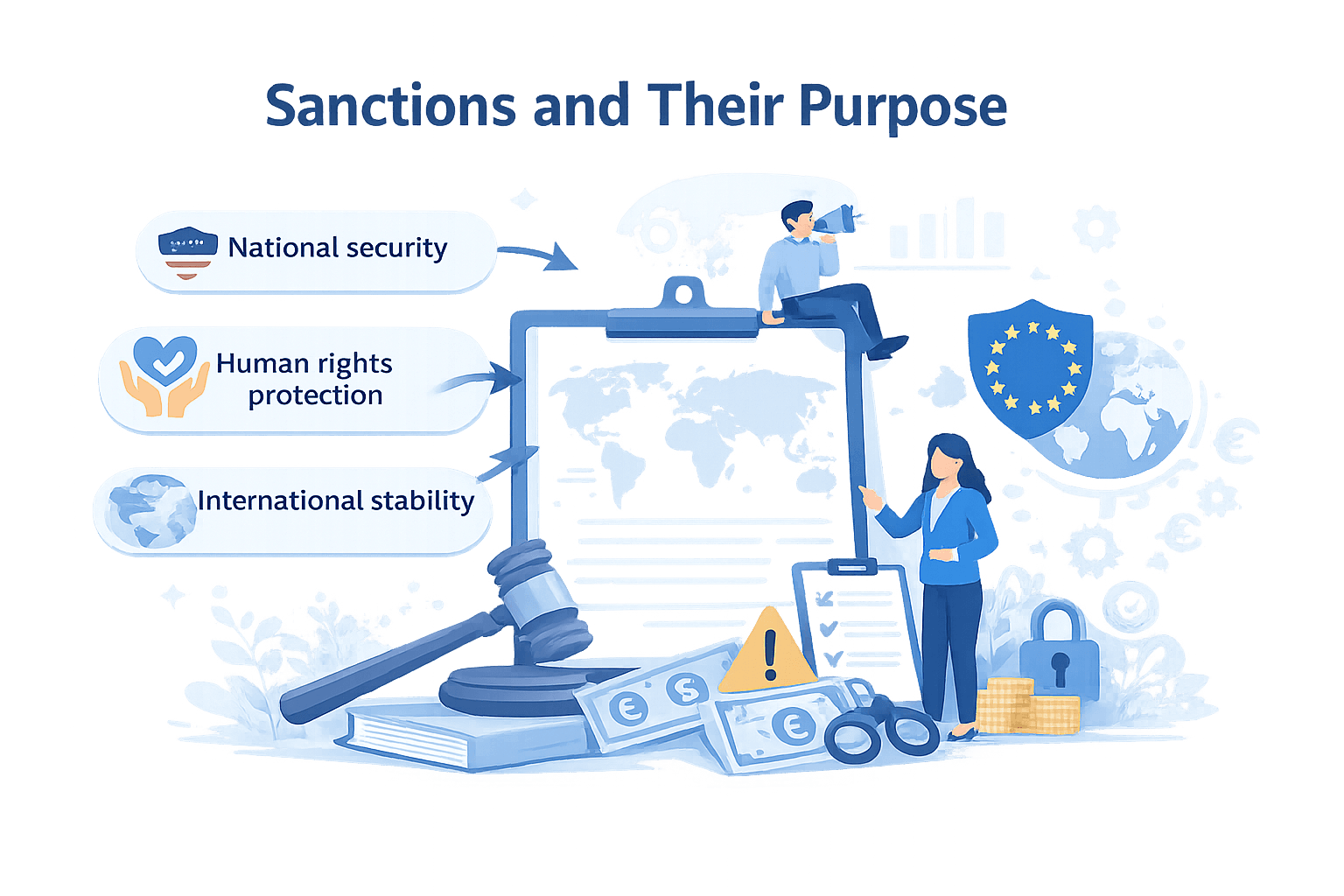
2. Why do sanctions exist?
Sanctions are used to:
- reduce terrorism financing,
- stop weapons proliferation,
- respond to human rights abuses,
- fight corruption and organized crime,
- respond to threats to international peace and security.
Sanctions are a policy tool. They are designed to change behavior by limiting access to money, goods, services, and technology.
3. Why sanctions matter for companies
Sanctions affect companies of all sizes. Violations can lead to:
- blocked payments or frozen funds,
- shipments stopped by banks or logistics partners,
- legal penalties (civil or criminal, depending on jurisdiction),
- loss of customers and partners,
- reputational damage,
- bank de-risking (banks may refuse to work with you).
Important: sanctions risk is not only a “bank problem.” It affects:
- logistics companies,
- marketplaces,
- PSPs,
- fintechs and crypto companies,
- B2B SaaS and cross-border service providers.
4. The most important rule
Do not provide value to a sanctioned party.
This includes direct and indirect value, such as:
- paying them,
- shipping goods to them,
- providing services to them,
- enabling them through an intermediary.
5. Where sanctions risk enters (simple examples)
Sanctions risk can enter when:
- onboarding a new customer or merchant,
- paying a supplier,
- accepting a third-party payer,
- shipping to a new destination country,
- using an agent/reseller/distributor,
- providing software access to users in high-risk regions.
Knowledge check (2 questions)
- Sanctions can restrict only goods, not services. True or false?
- If the customer is not listed, there is no sanctions risk. True or false?
Answers
- False. Sanctions can restrict goods and services.
- False. Country/region and sector restrictions can apply even if the customer is not listed.
Next, learn the main types of sanctions and how they apply in EU and US regimes.
Related reading
Module 6 — Checklists and Templates (Audit-Ready)
Print-ready employee checklists: daily safety checklist, escalation template, and evidence pack checklist.
Module 5 — Industry Scenarios (PSP, Marketplace, Fintech/Crypto, Freight Forwarder)
Practical scenarios with red flags, correct actions, and evidence pack requirements for high-risk industries.