29 Aug 2026
AML Evidence Management Software: What to Look For in an Audit-Ready Platform
A practical buyer's guide to AML evidence management software: the evaluation criteria compliance teams use to pick an audit-ready platform, what examiners and bank partners actually request, where tools like Vanta stop, and how MatchAudit fits.
AML Evidence Management Software: What to Look For in an Audit-Ready Platform
Disclaimer: This article is educational and does not constitute legal, regulatory, or procurement advice. AML/CFT obligations, supervisory expectations, and audit standards vary by jurisdiction and licence type. Validate any evaluation criteria against your own regulatory perimeter and your compliance counsel. Product descriptions reflect publicly available positioning at the time of writing and are not endorsements.
Quick links:
Featured snippet
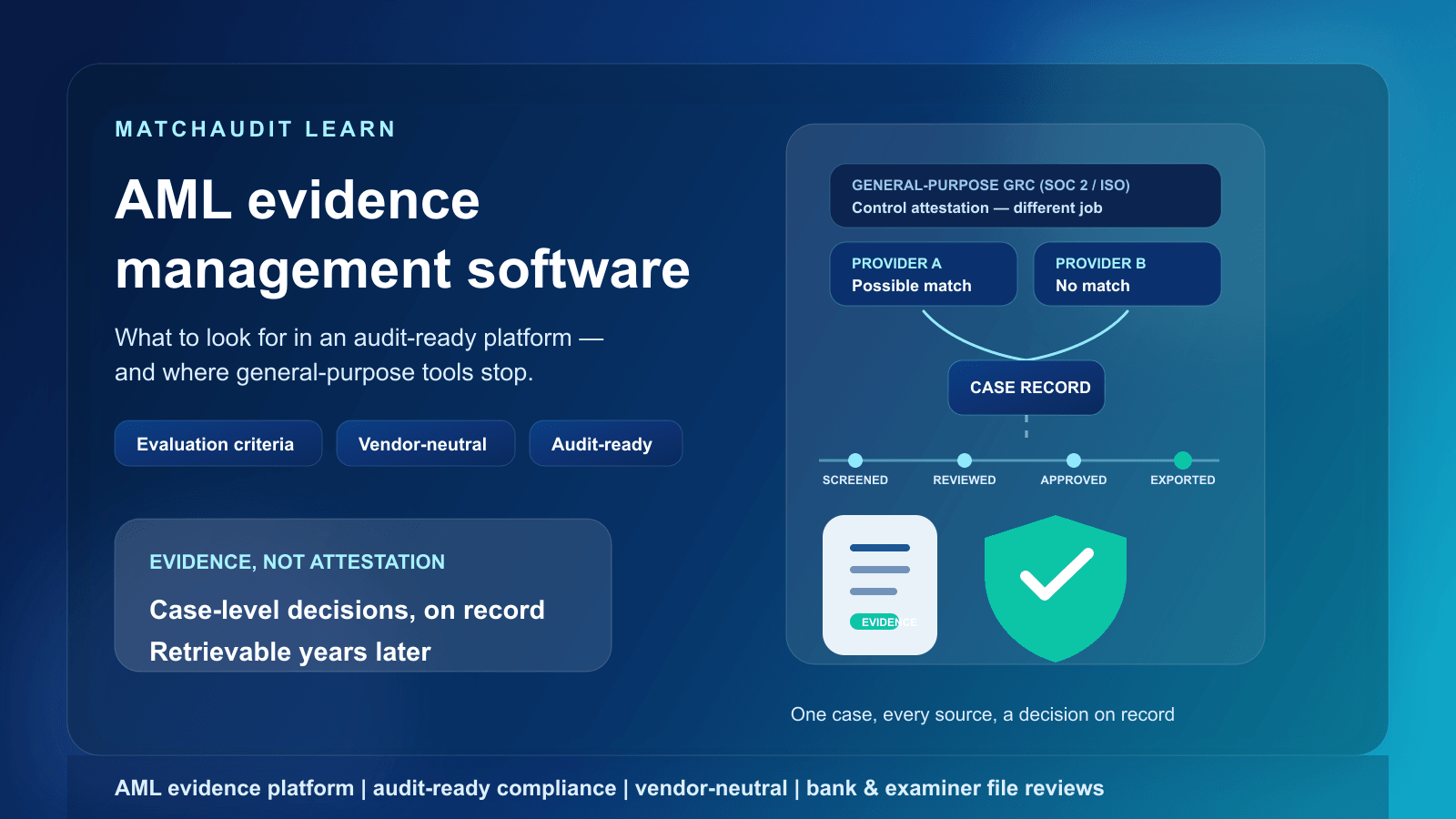
AML evidence management software is a system that captures, organises, and preserves the proof behind anti-money-laundering decisions — screening results, match adjudications, EDD findings, alert dispositions, reviewer rationale, approvals, and the audit trail — so that a specific decision on a specific customer or counterparty can be retrieved and defended months or years later. It is distinct from a screening tool (which produces the signal), a document repository (which stores files without decision context), and a security-compliance platform such as Vanta (which automates evidence for SOC 2, ISO 27001, and similar IT/security frameworks, not case-level AML supervision).
Contents
- Key takeaways
- What "AML evidence management software" actually means
- Why compliance teams start looking for a platform
- What auditors, examiners, and bank partners actually request
- The 12 evaluation criteria: what to look for
- Vendor and procurement diligence a compliance buyer should not skip
- Where Vanta fits — and where it stops
- Build vs. buy vs. "we already have SharePoint"
- Copy/paste evaluation scorecard
- Frequently asked questions
- How MatchAudit fits
- Official sources
- Related reading
Key takeaways
- The job is "reconstruct any decision on demand," not "store documents." An AML evidence management platform earns its place only if a reviewer who wasn't in the room can pull a case from two years ago — inputs, source, result, rationale, approval — in minutes.
- Audit-readiness is a property of the record, not the process. Regulators and bank partners sample individual customer files. A polished policy PDF does not survive a file review; a retrievable, decision-level record does.
- Vendor neutrality matters more than it looks. Most teams run more than one screening or monitoring source over time. If the platform can only hold "one result," you lose the history the moment you switch providers.
- General-purpose GRC and security-compliance tools solve a different problem. Vanta, Drata, Secureframe and similar platforms automate control evidence for SOC 2, ISO 27001, HIPAA, and GDPR. They are excellent at that. They are not built around AML domain objects — screened subjects, list versions, match dispositions, SAR/STR decisions, the 50% ownership rule — and they do not hold the case-by-case decision record an AML examiner samples.
- Scope discipline protects your budget. You are buying an evidence and decision layer, not a "compliance operating system." Overbuying a configurable enterprise suite you will not staff is a common, expensive mistake.
What "AML evidence management software" actually means
The phrase gets attached to several different product categories, so it's worth being precise before you shortlist anything.
| Category | What it does | What it is not |
|---|---|---|
| Screening / monitoring tools (sanctions, PEP, adverse media, transaction monitoring) | Generate the signal — matches, alerts, risk scores | A record of what you decided and why |
| Document repositories (SharePoint, Google Drive, DMS) | Store files | Aware of subjects, cases, decisions, list versions, or approvals |
| Case management inside a screening vendor | Track alerts within that one vendor's workflow | Vendor-neutral; portable when you switch providers |
| GRC / security-compliance automation (Vanta, Drata, Secureframe, OneTrust) | Automate control attestations and evidence for SOC 2, ISO 27001, GDPR, HIPAA | Built for financial-crime supervision or case-level AML file reviews |
| AML evidence management platform | Hold the decision record: subjects, sources, results, rationale, approvals, audit trail, export — vendor-neutral, retrievable for years | A detection engine, a legal adviser, or a replacement for your screening provider |
An AML evidence management platform sits downstream of detection and upstream of the auditor. Its unit of work is not the alert or the document — it is the decision: this customer, this counterparty, this transaction, screened against this source on this date, reviewed by this person, approved by that person, for these documented reasons.
Quick test for any tool a vendor calls "AML evidence software": ask them to show you how you would answer the request "Send us the sanctions screening file for the merchant you onboarded in March last year, including any matches you reviewed and cleared." If the answer involves exporting from three systems and someone's memory, it is not an evidence management platform.
Why compliance teams start looking for a platform
Almost nobody buys AML evidence management software speculatively. The search usually starts because one of these landed:
- A sponsor bank or acquirer periodic review. A payments company, PSP, EMI, or fintech sits inside a bank's risk appetite. The bank samples onboarding and transaction decisions and asks for the file behind each one.
- A regulatory examination or thematic review. The FCA, BaFin, DNB, CBI, or another supervisor asks for a walk-through of specific customer relationships and the decisions made on them.
- An external audit — financial statement audit with an AML component, a licence-condition audit, or an independent AML program test under an OFAC-style framework.
- A new licence application or passporting where the regulator wants evidence the control framework operates, not just that it exists on paper.
- M&A or fundraising due diligence. An acquirer's or investor's compliance diligence asks the target to produce decision records at speed. Weak evidence retrieval is a valuation and deal-risk issue.
- An internal near-miss. A decision that should have been easy to defend took three days to reconstruct, and someone senior noticed.
Every one of these is the same underlying event: a third party wants to see a specific decision, and the clock is running. That is the problem the software has to solve. Keep it in front of you through every demo.
What auditors, examiners, and bank partners actually request
This is the part vendors gloss over, so anchor your evaluation in what reviewers actually ask for. Across sanctions and broader AML file reviews, the request nearly always resolves to four questions about a specific subject:
- What was screened or reviewed? Exact legal names, trading names, identifiers, dates of birth, jurisdictions, registration numbers — the values that were actually entered, not what the customer file says today.
- When, and against what? The date of the check and the source or list version it ran against. Sanctions and watchlist data change continuously; a decision made against last quarter's data needs to be identifiable as such.
- What was the result — including anything you looked at and cleared? Not a "no hit" badge. The full output, any possible matches, which fields matched, which differentiators were checked, and why a match was or wasn't treated as real.
- Who decided, and who approved? The reviewer and the approver as distinct, timestamped actions — maker/checker — even when they reach the same conclusion.
The US FFIEC BSA/AML Examination Manual describes this almost verbatim for OFAC: examiners sample accounts and transactions and evaluate the filtering criteria used, the timing of the search, and the documentation maintained evidencing the searches. The Wolfsberg Group's guidance on sanctions screening frames the same expectation around list management and lookbacks. OFAC's Framework for Compliance Commitments evaluates whether internal controls — including recordkeeping — actually functioned. In the EU, EBA/GL/2024/14 and EBA/GL/2024/15 set governance and screening-control expectations — with GL/2024/15 aimed specifically at payment service providers and crypto-asset service providers — both applicable from 30 December 2025.
None of these frameworks ask for a description of your process. They ask whether one decision, on one subject, at one point in time, can be shown — with the inputs, the source, the result, and the reasoning intact.
Your evaluation criteria below map directly onto making those four questions answerable in minutes.
The 12 evaluation criteria: what to look for
Use these as demo scripts. For each one, make the vendor show you the behaviour on realistic data — not a slide.
1. It models AML domain objects, not generic "records"
The platform should natively understand subjects (entities, individuals, beneficial owners, directors, counterparties), their role in a relationship, screening/monitoring events, matches and dispositions, decisions, and approvals. If everything is a "document" with tags you invented, you are buying a repository and doing the modelling yourself — which means every reviewer models it slightly differently, and consistency across cases (something auditors specifically test) collapses.
Demo ask: "Onboard a company with two beneficial owners, screen all three, clear a possible match on one, and show me the resulting record structure."
2. Vendor neutrality and multi-source support
You will change screening providers. You will run a second tool for a while during migration. You will layer a regional list check or a manual lookup on top of a global provider. The platform must hold results from multiple sources as discrete evidence items on the same case, source-labelled, without one overwriting another — and it must retain historical results after you switch.
Demo ask: "Attach a result from Provider A and a conflicting result from Provider B to the same subject. Show me how a reviewer documents which one the decision relied on."
3. It's a decision record, not just storage
The core artefact is the decision: outcome (clear / escalate / block), the rationale in the reviewer's words, what differentiators were checked on a possible match, and the link back to the business relationship. Storage of the underlying PDF is necessary but not sufficient.
Demo ask: "Show me a cleared possible-match case. Can I read why it was cleared without calling the analyst?"
4. Reviewer accountability: maker/checker with named approvals
Reviewer and approver must be separately identified and separately timestamped. "Cleared" with a single name is a common file-review failure. The platform should make it structurally impossible to record a decision without recording who approved it.
Demo ask: "Try to approve your own review. What stops you?"
5. Integrity and tamper-evidence
Evidence files should carry an integrity value (e.g. a SHA-256 hash) captured at upload, and the decision record should be versioned so edits are visible rather than silent. A reviewer needs to be able to say "this file is unaltered since we captured it" and "here is what the record looked like when the decision was made."
Demo ask: "Edit a rationale after approval. Show me what an auditor would see."
6. Retention and retrievability by subject, case, and date
Retrieval is the whole product. The test is not "can you find last week's case" — it's "can a reviewer unfamiliar with the case find a decision from three years ago by customer name, case ID, or date, in minutes." Confirm the retention period is configurable to your longest applicable obligation and that retrieval performance doesn't degrade as volume grows.
Demo ask: "Search for a case by beneficial owner name only. Now by date range. Now export it."
7. List / dataset version capture
For sanctions and watchlist screening, the record should capture which list or dataset version a decision was based on — or at minimum the source and a "data as of" timestamp — so a lookback is possible if a list changes retrospectively. Wolfsberg calls this out explicitly.
Demo ask: "For a screening result from six months ago, what does the record tell me about the list data behind it?"
8. Export quality: reviewer-readable packs, not data dumps
The output a bank or auditor receives should be a structured, readable evidence pack — record summary, subjects, sources, results, rationale, approvals, audit timeline — that someone can read without a walkthrough call. A CSV of database rows or a ZIP of screenshots fails this.
Demo ask: "Generate the export you'd send to a sponsor bank. Hand it to me and let me read it cold."
9. Organisation isolation and access control
Multi-tenant platforms must enforce tenant isolation server-side (not just by hiding UI), with role-based access, least privilege, and an access model you can explain to your own auditor. Ask specifically how one customer's evidence is prevented from being visible to another, and how privileged/support access is controlled and logged.
Demo ask: "Walk me through your tenant isolation model and your internal access controls."
10. Complete, immutable audit trail
Every material action — created, screened, reviewed, escalated, approved, edited, exported, deleted — should be captured in an append-only trail with actor and timestamp. This is both an examiner expectation and your own protection.
Demo ask: "Show me the full event history for one case."
11. Data residency and sub-processors
Confirm where evidence data is stored and processed (EU, UK, US), whether residency is configurable, the list of sub-processors, and how sub-processor changes are notified. For EU PSPs and CASPs under the EBA guidelines, and for anyone under GDPR, this is a gating question, not a nice-to-have.
12. A real integration path — and a real exit
There should be a supported way to get evidence in (API, webhook receiver, structured import) and, critically, a clean way to get everything out if you leave — full export in an open format, including files and audit trail. Ask what account termination looks like and how long you retain access to export.
Watch out for the inverse failure: a platform that requires a six-month implementation, a dedicated admin, and a workflow-builder certification before it produces a single usable evidence pack. For most non-bank AML teams, time-to-first-defensible-record should be measured in days.
Vendor and procurement diligence a compliance buyer should not skip
The product can be right and the vendor still wrong. Before signing:
- The vendor's own security posture. Ask for their SOC 2 Type 2 report or ISO 27001 certificate. If they rely on a certified infrastructure provider (common for smaller vendors), that can be reasonable — but they should be transparent that the certification covers the platform provider, not necessarily the vendor's application layer, and be able to describe their own application-security controls.
- A Data Processing Agreement that reflects your regulatory context, with defined sub-processors, breach notification timelines, and deletion/return terms.
- Business continuity and uptime. Published SLA, incident history, backup and restore practices, and what happens to your evidence if the vendor has an outage during an audit window.
- Pricing model sanity. Per-seat, per-case, per-record, or flat? Model it against your realistic 24-month volume. Watch for pricing that punishes you for retaining evidence — retention is the point.
- Roadmap vs. reality. Separate what is live today from what is "coming." Ask which capabilities are in production for existing customers and which are in development. Do not buy a roadmap.
- Concentration and lock-in. If this becomes your system of record for AML decisions, how hard is it to leave? Re-confirm criterion 12.
- Reference conversations with a customer in a similar regulatory position, if the vendor can arrange them.
- Founder/team domain credibility. AML evidence is a domain problem. A vendor team that can't discuss the 50% ownership rule, match adjudication, or SAR/STR decision documentation will build the wrong abstractions.
Where Vanta fits — and where it stops
Compliance teams frequently ask a fair question: "We already use Vanta — can't it do this?" It's worth answering precisely, because the answer is "yes to one job, no to the other."
What Vanta (and Drata, Secureframe, and similar) are genuinely good at
These platforms automate security and privacy compliance. They connect to your cloud infrastructure, identity provider, HR system, and code repositories, and continuously collect evidence that controls are operating — for frameworks like SOC 2, ISO 27001, ISO 27701, HIPAA, GDPR, PCI DSS, and NIST. They manage policy acknowledgement, access reviews, vendor risk, security questionnaires, and auditor collaboration. For a company that needs a SOC 2 report to sell to enterprise customers, this is a category-defining, time-saving tool. Nothing below is a criticism of that.
Why that model doesn't cover AML evidence
The security-compliance automation model is built around control attestation: does control X exist, and is it operating? Evidence is collected automatically by integrating with systems that emit configuration and access data. That works because security controls are largely machine-observable.
AML supervision works differently. An examiner or bank reviewer does not ask "does a screening control exist." They pull one customer file and interrogate the human judgement inside it — why this possible match was cleared, why this alert was closed, why this beneficial owner was assessed as low risk, why this transaction was released. That evidence is not machine-observable configuration; it is a case-level decision with documented reasoning, and it has to be retrievable per-subject for years.
Specifically, general-purpose GRC / security-compliance platforms typically do not:
- Model AML domain objects — screened subjects and their roles, match dispositions, list/dataset versions, EDD findings, alert outcomes, SAR/STR decisions
- Hold vendor-neutral screening results from multiple providers on one case without overwriting
- Capture the reviewer rationale and maker/checker approval for an individual customer decision as the primary artefact
- Support the "pull this specific decision from three years ago by customer name" retrieval pattern an AML file review depends on
- Produce a reviewer-readable AML evidence pack for a sponsor bank, acquirer, or financial-crime supervisor
- Understand jurisdiction-specific tests such as the EU/UK 50% ownership and control rule
The short version: Vanta answers "is our security program in place?" for a SOC 2 auditor. It is not designed to answer "show me the sanctions screening decision on merchant X from Q1 last year, including the match you cleared" for a bank partner or an AML examiner. Those are different audits, different evidence, and — realistically — different tools.
You may well run both: a security-compliance platform for your SOC 2 / ISO posture, and an AML evidence management platform for financial-crime decisions. They don't overlap.
Build vs. buy vs. "we already have SharePoint"
Most teams evaluating AML evidence management software are currently running one of three DIY setups. Each has a predictable failure mode under audit:
| Current setup | Why it feels fine day-to-day | How it fails a file review |
|---|---|---|
| Spreadsheet + shared drive | Cheap, flexible, everyone knows it | No enforced structure, no maker/checker, no audit trail, evidence scattered; reconstruction takes days and some items are unrecoverable |
| Case management inside the screening vendor | Already there, integrated with alerts | Locked to one vendor; switching providers strands history; not designed as a cross-source system of record |
| Internal build on top of your app database | Fits your workflow exactly | Real ongoing cost: retention, integrity, export formatting, access controls, and list-version capture are all more work than they look, and they compete with revenue work |
Buying makes sense when: evidence retrieval has already caused a fire drill; you're regulated or bank-sponsored and file reviews are routine; you run or expect to run more than one screening source; or you simply can't justify a solo founder's or small team's engineering time on evidence plumbing. Building makes sense when your requirements are genuinely unusual and you have the engineering capacity to own it indefinitely.
Copy/paste evaluation scorecard
Score each item 0 (absent) – 2 (strong). Anything scoring 0 on items 1–8 is likely disqualifying for an audit-facing use case.
AML EVIDENCE MANAGEMENT PLATFORM — EVALUATION SCORECARD

Vendor: ______________________   Date: __________   Evaluator: __________

CORE (disqualifying if weak)
[ 0 1 2 ] 1.  Models AML domain objects (subjects, roles, matches, decisions, approvals)
[ 0 1 2 ] 2.  Vendor-neutral; holds multiple sources on one case; retains history after switch
[ 0 1 2 ] 3.  Decision record (outcome + rationale + differentiators), not just file storage
[ 0 1 2 ] 4.  Maker/checker: reviewer and approver separately identified and timestamped
[ 0 1 2 ] 5.  File integrity value (e.g. SHA-256) + versioned record; edits visible
[ 0 1 2 ] 6.  Retrieval by subject / case / date; performance holds at volume; retention configurable
[ 0 1 2 ] 7.  Captures list/dataset version or "data as of" for screening results
[ 0 1 2 ] 8.  Export = reviewer-readable evidence pack, not a data dump

PLATFORM
[ 0 1 2 ] 9.  Server-side tenant isolation; RBAC; privileged-access controls explained
[ 0 1 2 ] 10. Complete append-only audit trail (create > screen > review > approve > export)
[ 0 1 2 ] 11. Data residency known/configurable; sub-processor list and change notice
[ 0 1 2 ] 12. Real ingestion path (API/webhook/import) AND clean full-export exit

VENDOR
[ 0 1 2 ] 13. Vendor security posture (SOC 2 / ISO 27001), stated transparently
[ 0 1 2 ] 14. DPA fits your regulatory context; deletion/return terms defined
[ 0 1 2 ] 15. Pricing doesn't penalise retention; modelled against 24-month volume
[ 0 1 2 ] 16. "Live today" vs "roadmap" clearly separated; not buying a promise
[ 0 1 2 ] 17. Time-to-first-defensible-evidence-pack measured in days, not months
[ 0 1 2 ] 18. Team demonstrates AML domain fluency (50% rule, match adjudication, SAR/STR)

Total: ____ / 36     Core subtotal (1–8): ____ / 16
Frequently asked questions
What is AML evidence management software?
It is a system that captures and preserves the proof behind AML decisions — screening and monitoring results, match adjudications, EDD findings, reviewer rationale, approvals, and the audit trail — under a stable reference, so any individual decision can be retrieved and defended during a bank review, regulatory examination, or audit. It sits between your detection tools and your auditors and is vendor-neutral by design.
What should I look for in an AML evidence management platform?
Prioritise: a real AML domain model (subjects, matches, decisions, approvals); vendor neutrality and multi-source support; a decision record rather than plain document storage; maker/checker with named approvals; file integrity and versioning; retrieval by subject, case, and date going back years; list/dataset version capture; and a reviewer-readable evidence pack export. Then check platform security, tenant isolation, data residency, audit trail completeness, and a clean data-export exit.
Can Vanta be used for AML evidence management?
Not really — they solve different problems. Vanta automates control evidence for security and privacy frameworks such as SOC 2 and ISO 27001 by integrating with your infrastructure and collecting machine-observable configuration and access data. AML file reviews interrogate case-level human judgement — why a match was cleared, why an alert was closed — retrievable per customer for years. Vanta is not built around AML domain objects, multi-provider screening evidence, maker/checker adjudication records, or the evidence-pack output a bank or financial-crime examiner asks for. Many teams run a security-compliance platform and a separate AML evidence platform.
How is AML evidence management different from a GRC tool or an audit-log product?
GRC tools manage risks, controls, and policies at the program level. Audit-log products record system events. An AML evidence management platform is narrower and deeper: its unit of work is the individual compliance decision — the subject screened, the source, the result, the reviewer's reasoning, and the approval — assembled into a retrievable, exportable record. A file review samples decisions, not programs, so decision-level evidence is what has to hold up.
What evidence do AML auditors and bank partners actually ask for?
For a sampled customer or transaction: what was screened or reviewed (exact identifiers used), when and against which source or list version, what the result was including any matches investigated and cleared, and who made and approved the final decision. A "no hit" screenshot without that context is generally treated as insufficient. The FFIEC BSA/AML manual describes examiners evaluating the filtering criteria, the timing, and the documentation evidencing the searches.
Do I still need my screening provider if I have an evidence management platform?
Yes. An evidence management platform does not detect anything — it does not replace sanctions screening, PEP and adverse-media checks, or transaction monitoring. It preserves what those tools return and what your reviewers decided, in one defensible, vendor-neutral record. The two are complementary.
How long does it take to get value from AML evidence management software?
For a focused evidence-and-decision layer, you should be able to produce your first defensible evidence pack within days. Be cautious of platforms that require lengthy implementation, a dedicated administrator, or workflow-builder configuration before they output a usable record — for most non-bank AML teams that cost outweighs the benefit.
How MatchAudit fits
MatchAudit is a vendor-neutral evidence and decision layer for financial-crime and sanctions compliance. It is built around exactly the criteria above — because those criteria describe what a bank review or examination actually tests.
- Screening Evidence Hub keeps the relationship, source material from external screening providers, deterministic checks, reviewer rationale, decisions, approvals, and export history in one versioned record, retrievable by subject or reference.
- Multiple providers, one case. Because the Evidence Hub stores source material as discrete evidence items rather than overwriting a single "result" field, a second provider's output — or a manual re-screen — becomes additional evidence on the existing case. Historical results stay attached when you change providers.
- Maker/checker by design. Reviewer rationale and approval are recorded as distinct, named, timestamped actions, so "who reviewed" and "who approved" are always separable — matching what examiners are trained to look for.
- Integrity and audit trail. Evidence files carry a SHA-256 value; the record is versioned; material actions are captured in an audit timeline.
- Evidence Pack export turns a case into a reviewer-readable file — record summary, subjects, sources, results, rationale, approvals, audit timeline — instead of a manual assembly job the week a request lands.
- Structural readiness highlights where a record is incomplete against the framework being prepared, before someone external finds the gap.
- Bounded automation. Narrow AI agents can prepare source-linked drafts of evidence work; none can approve a customer, clear a match, set risk, or make the final compliance decision. A human stays accountable.
What MatchAudit is not: a screening or monitoring engine, a legal adviser, or a security-compliance automation tool. The financial-crime and sanctions evidence layer is what is available today; operational-resilience (DORA) and merchant-risk evidence layers are on the roadmap, not shipped.
See it on a real case: run a screening for free and look at the evidence record it produces, or review the sample evidence pack with your compliance lead before your next bank or acquirer review. Pricing is on the plans page.
Official sources
- OFAC, A Framework for OFAC Compliance Commitments: ofac.treasury.gov
- Wolfsberg Group, Guidance on Sanctions Screening: wolfsberg-group.org
- FFIEC BSA/AML Examination Manual, Office of Foreign Assets Control section: bsaaml.ffiec.gov
- European Banking Authority, Guidelines on internal policies, procedures and controls to ensure the implementation of Union and national restrictive measures (EBA/GL/2024/14 and EBA/GL/2024/15): eba.europa.eu
- FCA Handbook, Financial Crime Guide, Chapter 7 — Sanctions, asset freezes and proliferation financing: handbook.fca.org.uk
- FATF, The FATF Recommendations: fatf-gafi.org