5 Jan 2026
Sanctions Risk Training Hub (EU + US Focus)
Employee training curriculum for EU and US sanctions: purpose, types, controls, your role, industry scenarios, and audit-ready checklists.
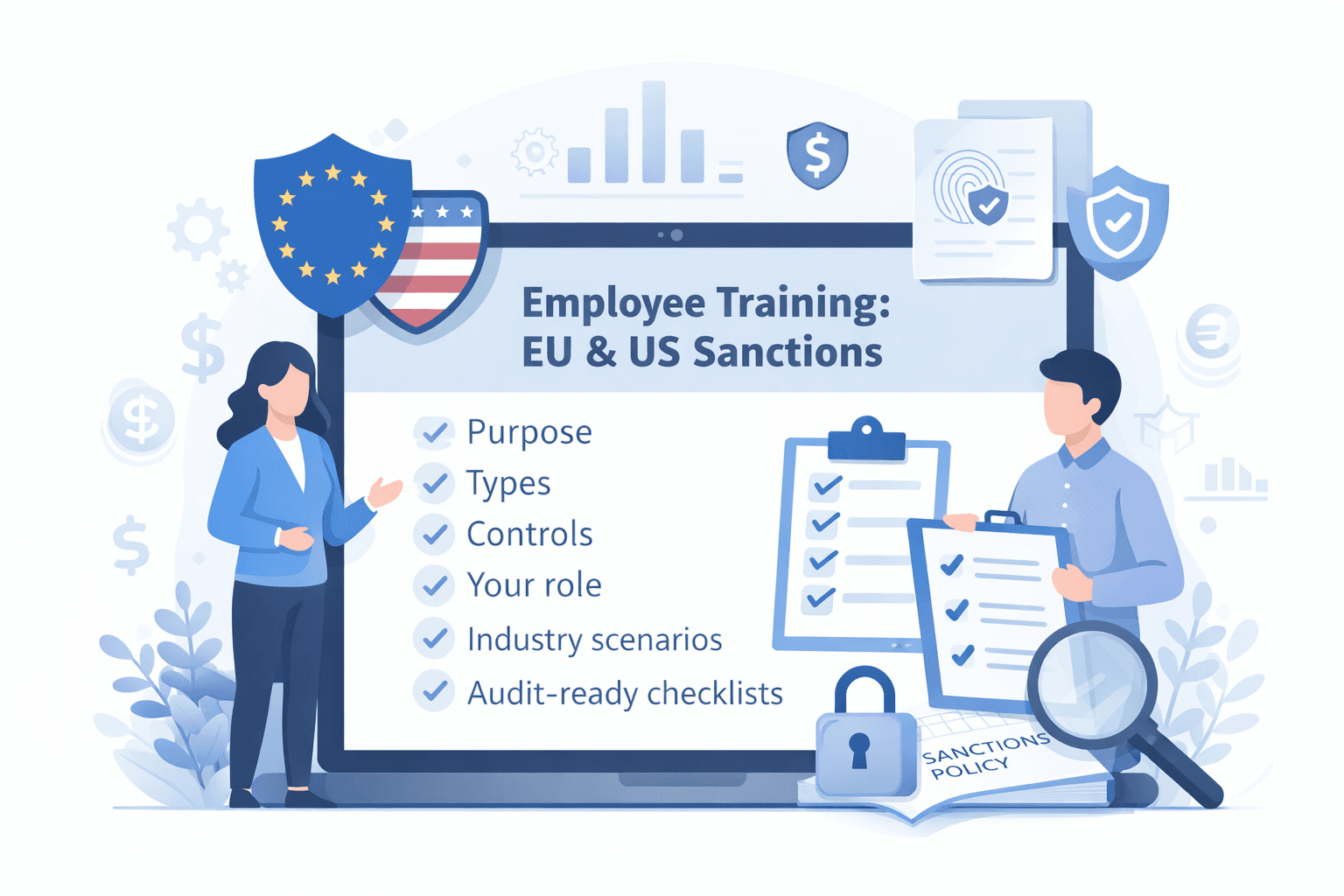
Sanctions Risk Training Hub (EU + US Focus)
A formal, practical sanctions training path for business employees working in payments and platform environments. It is designed to reduce real-world risk: processing prohibited transactions, enabling restricted deliveries, or providing services to sanctioned parties.
Who this training is for
Audience: Sales, Procurement, Finance, Operations, Logistics, Product, Support, Partnerships — especially in:
- PSPs, acquirers, processors
- Neo banks and fintechs
- Marketplaces and platforms
- Freight forwarders and cross-border logistics
How to use this hub
- Read modules in order (each builds on the previous one).
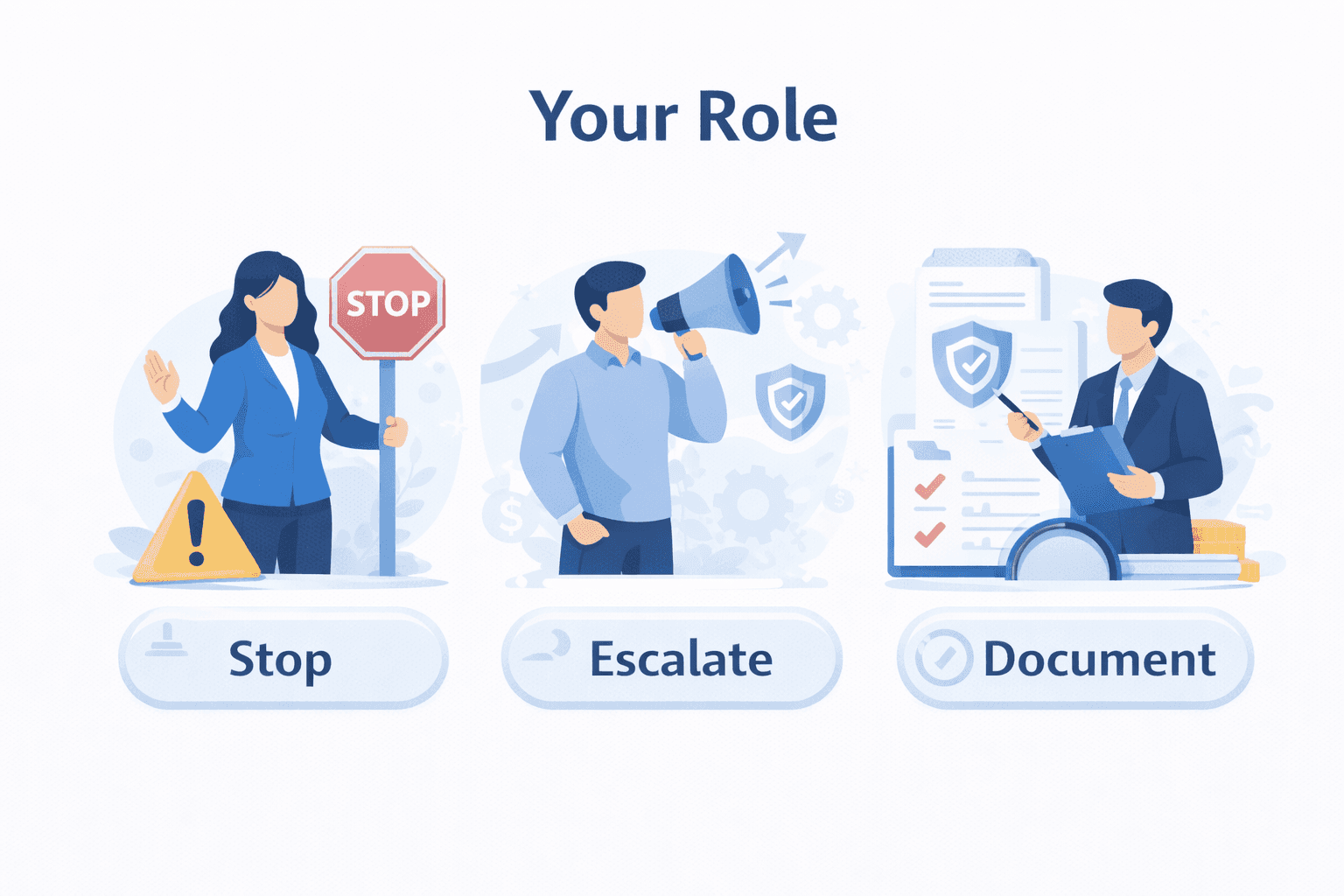
- Use the Stop → Escalate → Document rule as your default response when unsure.
- Keep the Module 6 checklists open during onboarding, payments, shipments, and escalations.
- If you want a practical feel quickly, run a free screening and review what an audit-ready output looks like.
Use MatchAudit to screen a name and see what an auditable result looks like: sources, match reasons, confidence, and structured evidence that supports escalation.
The core rule (memorize this)
If you see a match, close match, restricted geography, suspicious routing, or anything uncertain: stop the activity, escalate with evidence, and document every action in the system of record.
Training modules (complete path)
Follow these modules in order:
- Module 1: Sanctions and their purpose
- Module 2: Types of sanctions (EU + US)
- Module 3: How to protect your company from sanctions risk (controls and process)
- Module 4: Your role in mitigating sanctions risk (Stop, Escalate, Document)
- Module 5: Industry scenarios (PSP, marketplace, fintech/crypto, freight forwarder)
- Module 6: Checklists and templates (audit-ready)
Learning outcomes (what you will be able to do)
After completing this training, you should be able to:
- Explain what sanctions are and why they exist (EU + US focus).
- Recognize the four main sanctions patterns: list-based, country/region, sectoral, and secondary sanctions risk.
- Identify how sanctions risk appears in real workflows (onboarding, payments, payouts, refunds, shipments, digital delivery).
- Apply the company’s controls: screening, geo restrictions, ownership checks, transaction controls, and rescreening.
- Know when to pause activity and escalate to Compliance/Legal, with a complete evidence pack.
- Document actions and decisions in an audit-ready way that supports defensible outcomes.
Quick definitions (simple English)
- Counterparty: The person or company you do business with (customer, supplier, partner, seller, merchant).
- Screening: Checking names (and sometimes related data) against sanctions lists and risk sources.
- Match / hit: The screened name looks like a listed name (requires review; not automatically a breach).
- False positive: A match that is not the same person/entity.
- False negative: A real risk that was missed (highest risk outcome).
- End-user: Who finally receives the goods/services (can be different from the buyer).
- End-use: What the goods/services will be used for (can change risk).
- Payer: Who sends the money (can be different from the customer or account holder).
- Beneficiary: Who receives the money (can be different from the merchant/seller account owner).
- Ownership/control: Who ultimately owns or controls an entity (UBOs, directors, controllers).
Recommended training formats
Choose the format that matches your role and time.
Option A — Core path (45–60 minutes)
- Read Modules 1–4 (30 minutes)
- Review Module 5 scenarios relevant to your role (10–20 minutes)
- Save/print Module 6 checklists and templates (5 minutes)
Option B — Fast practical start (20–30 minutes)
- Run a free screening (5 minutes)
- Read Module 4 (Stop–Escalate–Document) (10 minutes)
- Use Module 6 escalation + evidence pack templates immediately (5–15 minutes)
Option C — Role-based refresher (10–15 minutes)
- Read Module 5 scenarios for your industry
- Keep Module 6 checklists open while you work
When to escalate (simple triggers)
Escalate whenever you see:
- a match or close match on a sanctions list,
- a restricted destination/region or suspicious routing/transshipment,
- a mismatch between who pays / who benefits / who receives goods,
- unusual beneficiary changes, repeated retries, or workaround requests,
- missing or inconsistent identifiers (DOB, address, nationality, ownership).
If uncertain: escalate. Do not self-clear.
Who to contact internally
If you see any uncertainty or potential sanctions issue, stop and escalate to:
- Compliance / Legal / Financial Crime team (use your internal escalation channel and case tool)
If your company has an on-call process or SLAs, follow them.
Begin with Module 1 for the full foundation. If you prefer hands-on learning, run a free screening first and then continue with Modules 2–4.
Appendix: Suggested internal policy alignment (optional)
This training works best when your company has:
- Clear rules on when screening is required (onboarding + transactions + rescreening)
- A defined escalation channel and response SLAs (including after-hours escalation where relevant)
- A standard evidence pack template (audit trail structure)
- Rules for re-screening on changes (ownership, geography, product scope, high-value deals)
- A clear approach to geo controls (restricted destinations, shipping blocks, digital delivery controls)
- A documented policy on customer communications during compliance review
If your company does not have these, you can still use this training. However, you should ask Compliance/Legal to confirm:
- what to stop,
- where to escalate,
- what to document,
- and what you are allowed to tell customers.
Related reading
Module 6 — Checklists and Templates (Audit-Ready)
Print-ready employee checklists: daily safety checklist, escalation template, and evidence pack checklist.
Module 5 — Industry Scenarios (PSP, Marketplace, Fintech/Crypto, Freight Forwarder)
Practical scenarios with red flags, correct actions, and evidence pack requirements for high-risk industries.