22 Sept 2026
Vendor Due Diligence Checklist: What Suppliers Should Prepare Before Enterprise Onboarding
A vendor-side due diligence checklist covering organization, security, privacy, resilience, financial, and evidence readiness — plus a self-assessment to score your gaps before a customer's review begins.
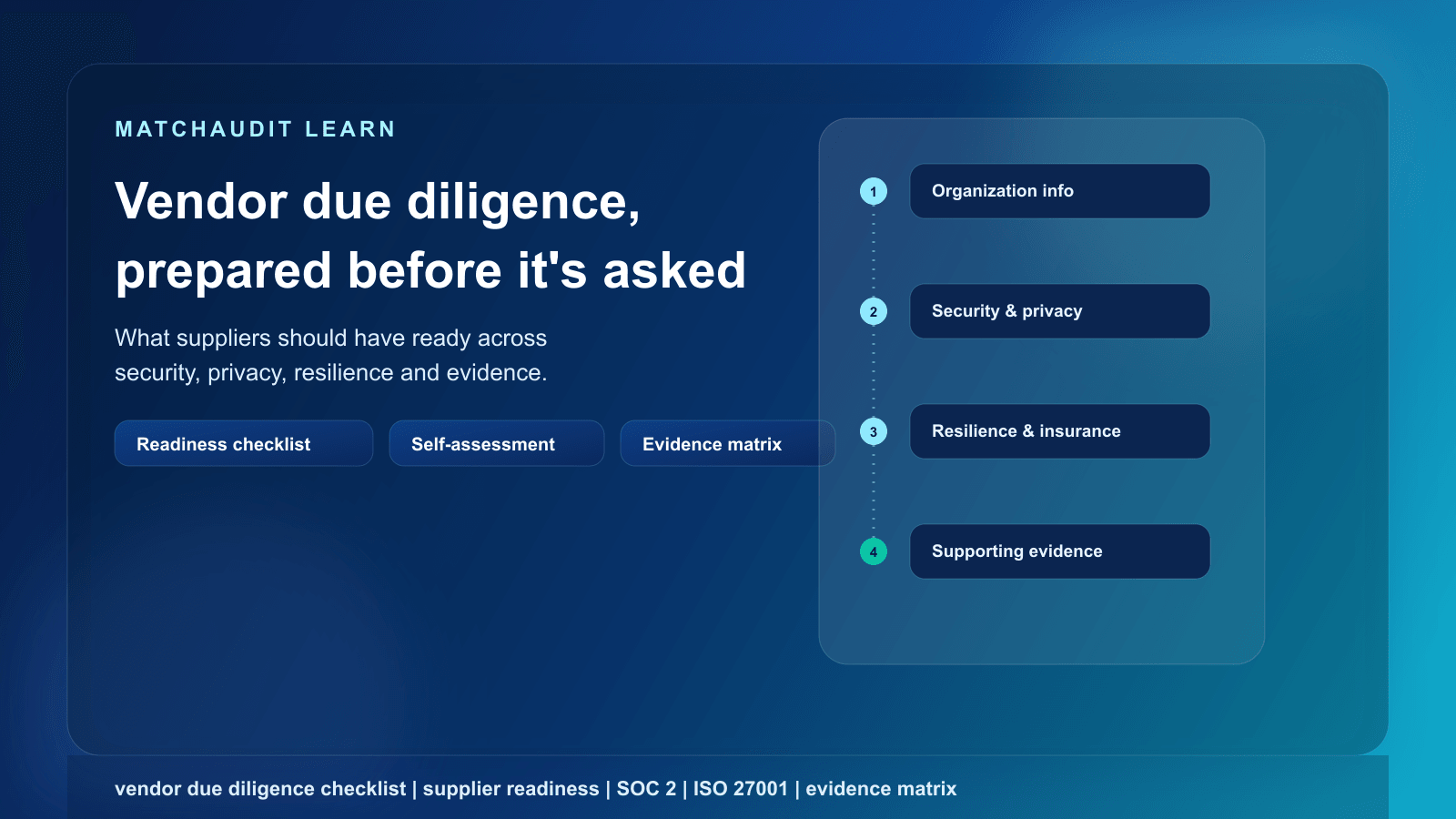
Vendor Due Diligence Checklist: What Suppliers Should Prepare Before Enterprise Onboarding
Last reviewed: 22 September 2026. This article describes common industry practice; it is not legal advice, and requirements vary by customer, industry, and jurisdiction.
Quick answer
Most vendor due diligence checklists are written for the buyer - what the customer's risk team should investigate about you. This one is written for the vendor: what to have ready before that investigation starts.
A practical readiness checklist for suppliers typically spans eight areas: organization information, security, privacy, resilience, financial standing, insurance, internal policies, and supporting evidence such as certifications, penetration-test results, and a subprocessor list. Not every customer will request every item - scope depends on the customer's industry, risk tier, contract value, and regulatory obligations. The goal is not to guess every possible question, but to have accurate, current, well-owned answers ready in one place before a customer's security or procurement team asks for them.
Contents
- Why most due-diligence checklists are written backwards
- The vendor due diligence checklist
- Self-assess your readiness
- Organization information
- Security
- Privacy and data handling
- Resilience and business continuity
- Financial information and insurance
- Policies, certifications, and penetration testing
- Subprocessors
- Organizing supporting evidence
- Related reading
- FAQ
Why most due-diligence checklists are written backwards
Search for "vendor due diligence checklist" and nearly every result is aimed at the enterprise doing the assessing: how to score a vendor's attack surface, how to prioritize vendors by risk tier, how to check financial health and fourth-party exposure before signing a contract. That content is useful - if you are the customer.
If you are the vendor, it tells you almost nothing about what to do with your own time. You don't control the customer's risk framework, their questionnaire template, or their approval workflow. What you can control is whether your organization, security, privacy, resilience, and evidence answers are accurate, current, and ready to hand over the moment a deal reaches security review.
That is the gap this checklist fills. It inverts the buyer-side list into a preparation list: for each category a customer is likely to investigate, what a vendor should have on hand before being asked.
Not every customer will request every item on this list. The scope depends on the customer's industry, risk tier, contract value, and regulatory obligations. A small SaaS deal with no data access may trigger a two-page form; a contract with a regulated financial institution can trigger a multi-week review across security, privacy, legal, and resilience. Use this as a preparation map, not a mandatory submission list.
The vendor due diligence checklist
| Category | Typical item requested | Why a customer may ask | Example evidence to have ready |
|---|---|---|---|
| Organization | Legal entity name, registration, ownership/group structure | To confirm who they are actually contracting with and screen for ownership or sanctions concerns | Certificate of incorporation, org chart, UBO declaration |
| Organization | Key personnel and escalation contacts | To know who owns security, privacy, and account escalations | Named contacts for security, privacy, and commercial escalation |
| Security | Information security policy and access-control approach | To understand how systems and data are protected | Security policy, access-control/IAM policy summary |
| Security | Encryption approach (at rest / in transit) | To confirm data protection standards match their risk tolerance | Architecture or data-flow summary describing encryption |
| Security | Vulnerability and patch management | To assess how quickly known issues are remediated | Vulnerability-management policy, patch cadence summary |
| Privacy | Data-processing description and DPA position | To confirm lawful basis, roles, and contractual data terms | Data-processing inventory, standard DPA |
| Privacy | Data residency and cross-border transfer position | To meet their own regulatory or contractual obligations | Hosting-location list, transfer-mechanism summary |
| Privacy | Data-subject rights process | To confirm requests can be fulfilled within required timeframes | Written process for access/deletion/correction requests |
| Resilience | Business continuity and disaster recovery plan | To assess the impact of an outage on their operations | BCP/DRP summary, recovery time/point objectives |
| Resilience | Uptime and incident history (where applicable) | To gauge historical service reliability | SLA terms, status-page history, uptime commitments |
| Financial | Financial statements or stability evidence | For larger or longer-term contracts, to assess going-concern risk | Recent financial statements or a credit/stability reference |
| Insurance | Cyber liability and E&O/professional indemnity coverage | To confirm recourse exists if something goes wrong | Certificate of insurance with coverage limits |
| Policies | Incident-response plan and notification commitments | To know how and when they'd be told about an incident |
A certificate or policy rarely closes a question by itself. Customers generally still want to know whether the document applies to the exact legal entity, product, environment, and geography they are buying - not just to the company in general.
Self-assess your readiness
Before building anything new, score where you actually stand. For each category, mark it Not started, In progress, or Ready.
| Category | Not started | In progress | Ready |
|---|---|---|---|
| Organization information | No consolidated entity/ownership record | Some details exist but scattered across sales/legal | Entity, ownership, and contacts documented and current |
| Security | No written policy or access-control description | Policy exists but not reviewed recently | Current policy, access-control approach, and vulnerability process documented |
| Privacy | No data-processing inventory or DPA template | Inventory or DPA exists but incomplete | Inventory, DPA, residency, and rights process ready to share |
| Resilience | No BCP/DRP | Plan exists but untested or outdated | Plan exists with recovery objectives and recent test evidence |
| Financial | No financial documentation prepared | Available on request but not organized | Financials or stability evidence ready for larger deals |
| Insurance | No current certificate on hand | Coverage exists but certificate is outdated | Current certificate of insurance ready to share |
| Policies | No incident-response or subprocessor-oversight policy | Policies exist but not consistently followed or current | Policies current, owned, and consistently applied |
| Certifications | No independent assurance | Certification in progress or lapsed | Current report/certificate with clear scope |
| Penetration testing | No recent test | Test done but findings unresolved | Recent test with remediation tracked to closure |
| Subprocessors | No maintained list | List exists but not kept current | List current, with disclosure/approval process for changes |
| Data handling | No data-flow documentation | Partial diagram or retention notes | Data-flow diagram and retention/deletion practice documented |
| Evidence organization | Evidence scattered across email, drives, and people | Centralized but not versioned or dated | Centralized, versioned, dated, and reusable across customers |
If most rows land in "Not started" or "In progress," that is normal for a company that hasn't faced a formal enterprise review yet - it is also the clearest early-warning sign that your next security review will take longer than the sales team expects.
Organization information
Before a customer's procurement or legal team can even route your deal to security, they typically need basic corporate facts: legal entity name and registration, ownership or group structure, and named contacts for security, privacy, and commercial escalation. This sounds trivial, but it's a common early stall point - especially for companies that have gone through name changes, holding-company restructures, or acquisitions and no longer have a single accurate record of "who we are, legally."
Have ready: certificate of incorporation or equivalent, a simple ownership/group-structure summary, and a short list of named owners for security, privacy, and account escalation - not just a generic support inbox.
Security
Security is the area most enterprise questionnaires spend the most time on, covering information-security policy, access control and identity management, encryption in transit and at rest, and vulnerability/patch management. Customers are not usually looking for a perfect environment - they are looking for evidence that controls are documented, owned, and actually followed, not written once and forgotten.
Have ready: a current information-security policy, a plain-language description of your access-control model (who can access customer data and how that's enforced), a summary of your encryption approach, and a description of how vulnerabilities are identified and patched.
Privacy and data handling
Privacy questions typically cover what personal or confidential data you process on the customer's behalf, where it's hosted and processed, how long it's retained, how it's deleted, and how you'd handle a data-subject access or deletion request. A data processing agreement (DPA) is commonly requested wherever personal data is in scope, and cross-border transfer questions come up whenever hosting or subprocessors sit outside the customer's jurisdiction.
Have ready: a data-processing inventory scoped to the service in question, a standard DPA you can execute without a lengthy negotiation, a hosting/processing-location list, a retention and deletion schedule, and a written process for handling data-subject requests.
Resilience and business continuity
Larger or operationally important contracts often prompt questions about what happens if your service goes down: do you have a business continuity plan, a disaster recovery plan, and recovery time/point objectives, and have you actually tested them recently? For customer-facing or revenue-critical services, uptime history and SLA terms may also come up.
Have ready: a BCP/DRP summary (not necessarily the full internal document), stated recovery objectives, evidence of a recent test or exercise if you have one, and your SLA/uptime commitments if applicable to the service.
Financial information and insurance
For smaller or lower-risk purchases, financial due diligence is often skipped entirely. For larger contracts, multi-year commitments, or services the customer considers operationally critical, financial statements, a credit check, or evidence of financial stability can become part of the review - particularly if the customer is concerned about vendor continuity risk. Insurance requests, especially cyber liability and errors & omissions/professional indemnity coverage, are also more common on larger deals or where the service creates meaningful liability exposure.
Have ready: recent financial statements or an alternative stability reference if you're a smaller or newer company, and a current certificate of insurance showing coverage type and limits.
Policies, certifications, and penetration testing
Beyond the security policy itself, customers may ask for an incident-response plan with stated notification commitments, an acceptable-use policy, and evidence that you manage your own subprocessors and suppliers responsibly (a policy for assessing and monitoring the vendors you depend on). Independent assurance - a SOC 2 report, ISO 27001 certificate, or similar - is commonly requested as supporting evidence, but it's worth being precise about what these actually are: a SOC 2 report describes controls tested against defined criteria over a specific period and scope; an ISO 27001 certificate confirms an information security management system was audited against that standard. Neither one automatically answers every question a customer might ask about your specific service, and neither should be presented as a substitute for actually completing their questionnaire.
Penetration testing is another common request: a recent test summary or attestation letter, plus evidence that findings were tracked to remediation rather than left open.
Have ready: incident-response plan with notification timelines, acceptable-use policy, a policy describing how you assess your own subprocessors, current certification documentation with a clear scope statement, and your most recent penetration-test summary with remediation status.
Subprocessors
If your service relies on other vendors - cloud hosting, email delivery, analytics, support tooling - to process customer data, many enterprise contracts require you to disclose that list and, in some cases, get approval before adding a new one. A maintained subprocessor list (name, purpose, data processed, location) is one of the most frequently requested - and most frequently out-of-date - pieces of evidence in a due-diligence pack.
Have ready: a current subprocessor list, and a defined internal process for reviewing and communicating changes before they happen, not after a customer asks why a new subprocessor appeared unannounced.
Organizing supporting evidence
The categories above only help if the underlying evidence is actually ready when asked for - not assembled from scratch the week a customer's security team opens a review. The recurring failure pattern is not a lack of good answers; it's that the good answers live in scattered emails, personal drives, and the memory of whoever handled the last similar request, with no record of which version is current, who approved it, or when it expires.
A more durable approach is to treat this evidence as a governed, reusable library rather than a one-off document exercise: version each item, record who approved it and when, track expiry or next-review dates, and reuse the same approved facts and documents across every customer relationship instead of rebuilding the answer set from zero each time.
This is the specific problem MatchAudit's Vendor Assurance workspace is built around. It lets a vendor store reusable evidence documents and approved company facts in one place with a human review step, track a per-customer readiness view showing what's missing, expired, or due for review, and manage several customer onboarding processes side by side instead of in separate spreadsheets and inboxes. When a customer sends a questionnaire, it can extract candidate requirements from the document for a person to review and accept, and suggest a draft response linked to your approved facts and evidence - with a human approving every response before it goes out. None of that replaces doing the underlying security, privacy, and resilience work; it just means the evidence you've already built doesn't have to be found and re-verified from scratch every time a new deal reaches review.
Related reading
- Vendor onboarding: the full lifecycle from first request to active customer
- Security questionnaires: what they cover and how to respond
- Third-party risk management for vendors: understanding the customer's lifecycle
FAQ
Does every customer require all of these documents? No. Scope depends on the customer's industry, risk tier, contract value, and regulatory obligations. A low-risk, low-data-access purchase may involve a short form; a contract with a regulated financial institution or a large enterprise can involve a full review across security, privacy, legal, and resilience. Treat this checklist as a preparation map, not a fixed submission requirement.
Is a SOC 2 report or ISO 27001 certificate enough by itself? Usually not on its own. These are valuable independent assurance, but a customer may still want to confirm the scope applies to the specific entity, product, and environment they're buying, and may still ask service-specific security, privacy, or resilience questions the certificate doesn't cover.
When should financial due diligence be expected? It's more common on larger contracts, multi-year commitments, or services the customer considers operationally critical, where vendor continuity risk matters to them. Smaller or lower-risk purchases often skip financial review entirely.
What's the difference between a due diligence checklist and a security questionnaire? A due diligence checklist is the vendor's internal preparation list - what to have ready across organization, security, privacy, resilience, financial, and evidence categories. A security questionnaire is the customer's specific set of questions, which may draw on some or all of those categories depending on their own risk framework.
How often should this evidence be refreshed? At minimum whenever something material changes - a new subprocessor, an expired certificate or insurance policy, a completed penetration test, a policy update - and independently of any single customer's request, so the same current evidence can be reused the next time it's needed.
Do we need a subprocessor list if we don't handle personal data? Possibly still yes, if your service relies on third-party infrastructure or tooling the customer's contract requires you to disclose regardless of data type. Check the specific contract language rather than assuming data handling is the only trigger.
Can AI fill out this checklist for us automatically? AI can help extract likely requirements from a customer's questionnaire and suggest draft answers linked to your approved facts and evidence, but a human should review and approve every response before it's sent. The underlying accuracy of your security, privacy, and resilience posture still has to be real - AI assistance speeds up organizing and drafting, not the underlying work itself.
Score yourself against the maturity table above before your next enterprise deal reaches security review - it's a faster way to find your actual gaps than waiting for a customer's questionnaire to find them for you. If you want a single place to keep that evidence current, reusable, and ready across every customer relationship, you can start free, see pricing, or talk to us about your current process.