2 Oct 2026
Vendor Due Diligence for SaaS Suppliers: The Complete Guide to Passing Bank and Regulated-Enterprise Assessments With Evidence That Gets Approved
How SaaS suppliers prepare a reviewer-ready evidence pack, answer bank due diligence questions, handle exceptions, and keep assessments current.

Last reviewed: 2 October 2026. This is a supplier-side preparation guide. Your customer's requirements and applicable law determine the actual assessment; no evidence pack guarantees approval.
Quick answer
To prepare for bank or regulated-enterprise due diligence, a SaaS supplier needs more than a completed questionnaire. Assemble a current description of the exact service and legal entity, a control owner for each risk domain, and evidence that demonstrates how the control operates. Then map each customer question to a concise answer, a relevant document or record, its scope and date, and any open exception. The customer's risk team still makes the approval decision.
The US interagency guidance on third-party relationships treats due diligence as one stage of a broader lifecycle and expects its depth to match the relationship's risk and complexity. For EU financial customers, DORA Article 28 calls for pre-contract assessment of ICT providers, with additional attention where a service supports a critical or important function. These are duties of the financial institution. They explain why the supplier receives detailed requests.
What determines how much scrutiny you receive?
Expect the buyer to ask what the product actually does, which systems it connects to, what data it can access, whether it can affect customer operations, and whether an outage would interrupt an important service. A read-only analytics tool with no production data may face a different review from a platform that processes account information or sits in a payment workflow. Your contract value alone does not describe those risks.
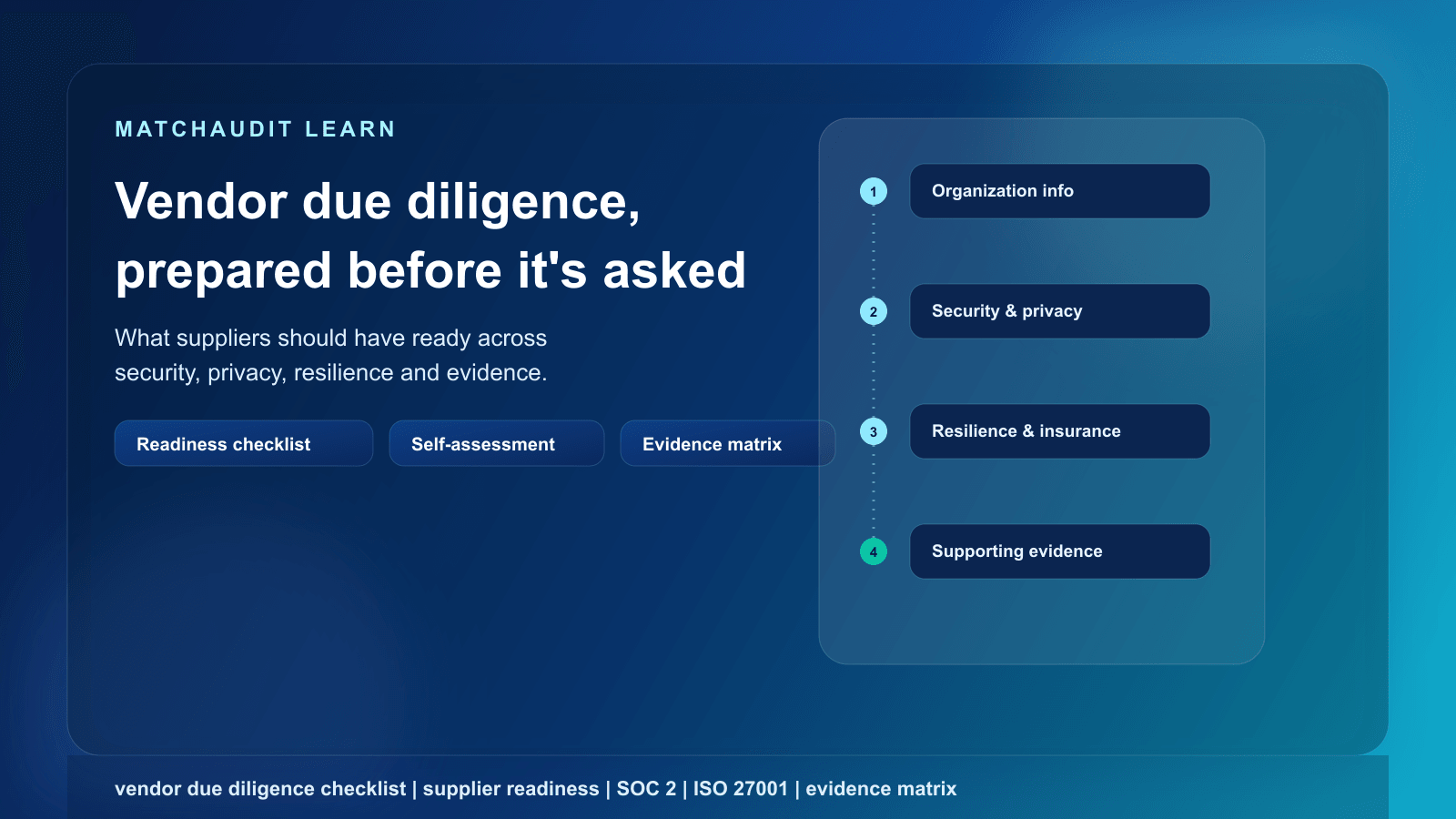
Prepare a one-page service boundary before any questionnaire: contracting entity; product and deployment model; customer and supplier responsibilities; data categories; hosting and processing countries; integrations and privileges; support access; key subcontractors; recovery commitments; and the date the description was approved. This prevents different teams from describing different versions of the same service.
The evidence pack a reviewer can use
| Review area | Typical question | Useful evidence and scope note |
|---|---|---|
| Company and viability | Who is the contracting entity, and can it deliver the service? | Registration, ownership structure, financial information or insurance where requested; identify the legal entity covered. |
| Security governance | Who owns security, and how are controls maintained? | Current security policy, risk review, control owners and independent assurance, with dates. |
| Access and development | Who can access production data, and how is software changed? | Access policy and recent review sample; change approval and secure development process. Redact sensitive details. |
| Vulnerabilities and incidents | How are issues found, prioritized and reported? | Vulnerability process, recent test summary and remediation status; incident plan and exercise or incident record. |
| Privacy and data | What is processed, where, and by whom? | Data flow, retention and deletion approach, DPA position, transfer information and current subprocessor list. |
| Continuity and exit | What happens during an outage or termination? | Backup and recovery design, test results, service commitments, export and deletion procedure. |
| Subcontracting | Which other providers support this service? | Subprocessor or ICT supply-chain record showing role, location, data access and change notification. |
The FDIC's community-bank guide illustrates how banks adapt reviews to a relationship's risk. The table above is a practical supplier preparation map, not a universal bank checklist.
For every item, record owner, version, effective date, service scope, customer-sharing level and next review date. A certificate for a parent company or cloud host can be useful, but state what it covers. ISO/IEC 27001 describes an information security management system; certification is evidence of that system within its certified scope, not proof that every feature or customer-specific obligation has been reviewed.
Turn documents into answers a bank can approve
A response should make one defensible claim at a time. For example, an answer to “Is privileged access reviewed?” should say who is included, how often reviews occur, who approves them, and which recent record demonstrates completion. “Yes, see security policy” leaves the reviewer to infer whether the practice actually runs.
Use a small response record for each requirement:
- Question and context: keep the buyer's wording, service scope and deadline.
- Answer: provide a plain-language statement with any necessary qualification.
- Source: link the specific policy section, certificate, test summary or operational record that supports it.
- Status: note the source's owner, date, expiration and any control gap.
- Approval: have the accountable security, privacy or legal owner review the final response before submission.
Share sensitive materials through the buyer's approved secure channel. A redacted penetration-test executive summary or a controlled report review may answer the question without distributing exploit details. If evidence is unavailable, say so and explain the control you do have, the gap owner and the realistic remediation date. Do not turn a planned control into a present-tense “yes.”
Where assessments often stall
The most expensive follow-up cycles usually start with mismatched scope: a certificate covers a different entity, the DPA names a different hosting region, a questionnaire says backups are tested annually while the recovery plan says quarterly, or the subprocessor list has no update owner. Another common blocker is a contract promise that the operations team cannot meet, such as an incident notification time or recovery target that has never been tested.
Review the evidence pack and draft contract together. DORA Article 30 specifies contractual elements for ICT services used by EU financial entities, with further requirements for services supporting critical or important functions. A supplier should be able to explain locations, service levels, incident assistance, access and audit arrangements, subcontracting and exit support as they apply to the offered service. Legal counsel should review commitments before signature.
A practical 30-day preparation plan
- Week 1: define the service boundary and assign owners for security, privacy, resilience, legal and commercial facts.
- Week 2: gather current evidence; mark missing, expired, restricted or out-of-scope documents.
- Week 3: draft a reusable answer library with citations to exact evidence, then have domain owners approve it.
- Week 4: run a mock bank request: answer ten likely questions, package files through a secure sharing route, and resolve contradictions.
Refresh the pack after a material change, not only at an annual renewal. New data flows, new subprocessors, incidents, product scope changes and expiring assurance can all make an otherwise good answer stale.
Where MatchAudit fits
MatchAudit's Vendor Assurance workspace can help a supplier keep approved facts and evidence documents together, track what is missing or due for review per customer relationship, and prepare human-reviewed questionnaire responses linked to their sources. It does not perform the underlying controls or make a bank's approval decision. If several assessments are running at once, explore Vendor Assurance or discuss your process.
Related reading
- Third-Party Risk Assessment for Vendors explains the questions banks tend to send.
- Third-Party Risk Management Framework for Suppliers maps DORA, SIG, CAIQ and ISO 27001.
- Vendor Due Diligence Checklist is a shorter inventory for initial preparation.
FAQ
Does an ISO 27001 certificate or SOC 2 report guarantee bank approval?
No. Independent assurance helps, but the buyer still checks its scope, period, exceptions and relevance to the service it is buying. It may request service-specific answers and contract terms.
What if our SaaS company is too small for a formal certification?
Describe the controls that exist and provide proportionate supporting records. State clearly which assurance you do and do not hold. The bank decides whether the residual risk is acceptable.
Who should own the final questionnaire response?
One coordinator should track the request, while security, privacy, legal and operations owners approve claims in their areas. The buyer should receive one consistent, reviewed submission.