Sanctions Screening API: How It Works, What to Compare, How to Test Free | MatchAudit Learn
Sanctions Screening API: How It Works, What to Compare, How to Test Free
How a sanctions screening API works, when to call it, what a good response contains, and eight criteria to compare providers. Includes free options and a sandbox.
•8 min read
A sanctions screening API lets your own software check a name against sanctions and restricted-party lists with one HTTP request, and get back potential matches you can review. You send the name of a customer, payee, supplier or partner. The API compares it with lists such as OFAC, the EU consolidated list, the UK Sanctions List and the UN Security Council list, and returns any similar listed entries with a score and a reference. A good API also tells you which list versions it searched, so you can show later what you checked and when.
This guide is for developers, product owners and compliance leads at fintechs, payment and marketplace platforms, SaaS companies and exporters. It covers where a screening call belongs in your flows, what a request and response look like, how to compare providers, and which free options exist. It is a technical guide, not legal advice. Which lists you must screen, and how you treat a match, depends on your business and the regimes that apply to it.
What a sanctions screening API does
Sanctions lists name people, companies, vessels and organisations that you may not deal with, or may only deal with under conditions. Each authority publishes its own list in its own format, on its own schedule. A screening API does three jobs so you do not have to:
Collects and normalises the lists. It fetches each official publication, parses it, and keeps names, aliases, name parts and non-Latin spellings searchable.
Matches names approximately. People's names are spelled and ordered differently across documents and alphabets. A useful API catches "Mohammed", "Muhammad" and reversed name order, and scores how close each candidate is.
Returns evidence. For each potential match, it returns the listed entry, the programme, the list reference and a link to the official source, plus the data date of each list it searched.
The API does not decide anything. A potential match is a reason for a person to look, not a confirmed designation. "No potential match" is not a statement that a transaction is permitted.
Where to call it in your product
Screening only helps if it happens before the step it is meant to control.
Customer onboarding: at sign-up or before an account is activated, as part of KYC or KYB.
Before money moves: before a payout, refund, withdrawal or payment to a new beneficiary.
Partner and supplier onboarding: before you sign a reseller, agent, supplier or marketplace seller.
Checkout and order release: before you ship goods or grant access to a digital service.
When details change: a new company name, a new beneficial owner, a changed shipping address.
When lists change: periodic re-screening of your existing customer base, because a clean customer can be designated tomorrow.
If you hold the call result and a later reviewer's decision in the same record, you have an audit trail rather than a log line. The guide on sanctions screening evidence for your bank explains what payment partners expect to see.
What a request and response look like
A typical call is a POST with one or more names. This is a request to the MatchAudit Sanctions API, using synthetic names:
The response has two parts. results holds, for each input name, whether there is a potential match, whether every list was searched, and the result per list. receipt is the record you keep: a screening ID, a UTC timestamp, the engine version and the data date and version of each list. A shortened, illustrative response:
Two fields deserve attention in any API you evaluate. First, a flag like complete: if one list could not be loaded, "no match" is not a full negative result, and your code should treat it differently. Second, the list data date: it is what lets you answer "were you screening against the current list on that day?" The full field reference is in the API documentation.
Eight criteria to compare sanctions screening APIs
List coverage. Which lists are included, and are they the ones your regimes require? At minimum most businesses selling in or from Europe look at the EU, UN, UK and US OFAC lists. Check national lists, export-control lists such as the BIS Entity List, and debarment lists if they apply to you. Ask for the list catalogue, not a count.
Freshness you can prove. How often lists are fetched matters less than whether each response states the data date of every list. Without it you cannot evidence what you screened against.
Matching quality. Test with spelling variants, transliterations, reversed names, company suffixes and partial names. Look at the score and what the match was made on, so a reviewer can explain a decision. The guide on preventing false positives covers tuning.
Unavailable lists. What happens when an upstream source is down? A silent "no match" is the worst answer. The API should mark the list as unavailable.
Batching and limits. How many names per request, and what is the rate limit? Bulk re-screening needs both.
Data protection. Names are personal data. Does the provider store or log the names you send? Where is it established, and under which law does it process them? Under the GDPR you need to understand this before you send customer data.
Evidence output. Does the response give you a receipt you can store with your own records, or do you have to build that yourself?
Pricing model and testing. Fixed monthly volumes or per-call billing with overage? Is there a sandbox you can integrate against before you pay?
There are three realistic free routes, each with limits.
Official sources. Authorities publish their lists for free: OFAC's Sanctions List Service, the EU's Financial Sanctions Files, and the UK Sanctions List. You can download and search them yourself. The cost is the engineering: parsing several formats, keeping them current, matching names approximately across alphabets and keeping evidence of which version you used.
Free one-off checks. Web tools that check one name at a time are fine for an occasional lookup. MatchAudit's free sanctions check searches the supported lists for a single name, with no sign-up, and shows the data date of every list. It has a daily limit per IP address and is not built for automated use.
Free API sandboxes. A sandbox lets you build and test your integration before you choose a plan. The MatchAudit Sanctions API has a public sandbox key, published in the documentation. It screens a synthetic test list only, so you can test request handling, matches and error cases without sending real names.
The MatchAudit Sanctions API
The MatchAudit Sanctions API screens names from your own systems against the supported sanctions and restricted-party sources, including UN, OFAC SDN and non-SDN, EU, UK, Swiss SECO, national, export-control and debarment lists. The full catalogue and each list's current data date are on the lists page.
One to 25 names per request, sent over HTTPS with an API key.
A screening receipt in every response, with a screening ID, UTC timestamp and the data date of each list.
Unavailable lists are marked, and a result is only flagged complete when every list was searched.
Names are processed in memory for the request and not written to the database or application logs.
Fixed monthly plans, starting at €29 per month. At the plan limit the API pauses until the next period; there are no overage charges. See current plans.
Free sandbox key for integration testing; a live key usually follows within one business day of subscribing, after a short company check.
MatchAudit UG (haftungsbeschränkt) is based in Germany and processes personal data under the GDPR. Screening results support your review. You remain responsible for your screening policy and every decision.
Frequently asked questions
What is a sanctions screening API?
It is a web service that your software calls to check a name against sanctions and restricted-party lists. It returns potential matches with a score, the list reference and the official source, so a person can review them.
Is there a free sanctions screening API?
Official list publications are free to download, but you have to build matching and keep them current yourself. Some providers, including MatchAudit, offer a free sandbox key for integration testing against synthetic data and a free web check for single names. Production screening of real names is usually a paid plan.
Which sanctions lists should an API cover?
It depends on where you operate and whom you serve. Businesses in or selling from Europe usually screen the EU consolidated list, the UN Security Council list, the UK Sanctions List and the US OFAC lists, plus national and export-control lists where relevant.
How often should I re-screen customers through an API?
Screen at onboarding and before key events such as payouts. Re-screen your existing customers when the lists you rely on change, and when customer details change. Each list update can add new designations.
Does a "no match" result mean I can go ahead?
No. It means no similar name was found in the lists searched at that time. Check that every list was actually searched, and remember that screening is one control among others, such as ownership checks and country restrictions.
Is sanctions screening through an API GDPR compliant?
Names are personal data, so you need a legal basis and an understanding of how your provider processes them. Check whether the provider stores or logs the names, where it is established and whether it acts as your processor.
Researched 28 November 2026. This is a technical guide, not legal advice. A potential match is not a confirmed designation, and screening does not make a business compliant with sanctions law.
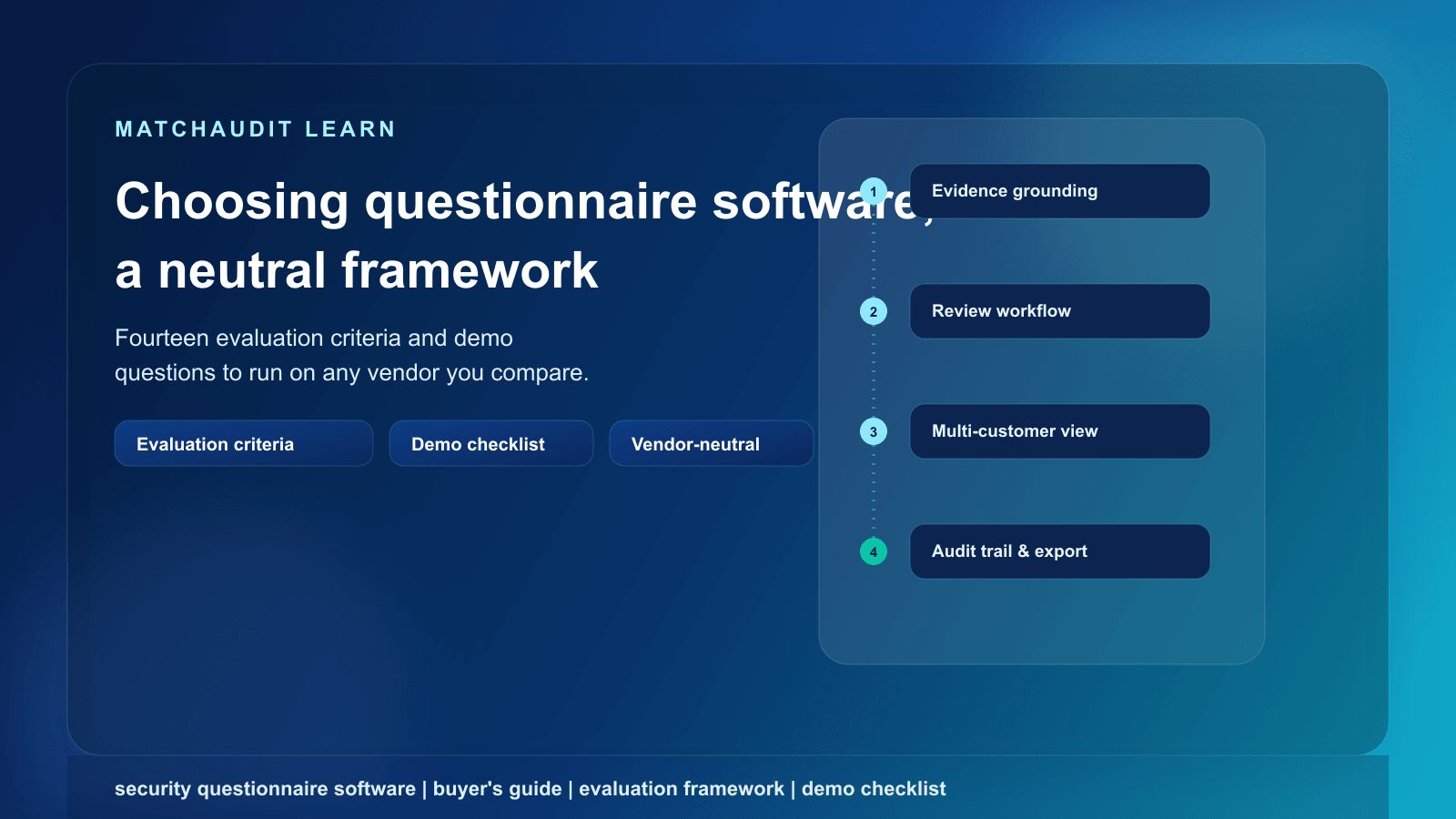
A neutral, criterion-by-criterion evaluation framework for choosing security questionnaire software — plus a demo checklist and blank scoring rubric you can apply to any vendor you're comparing.