26 Sept 2026
Vendor Security Assessment Questionnaire: Questions, Evidence and How to Respond
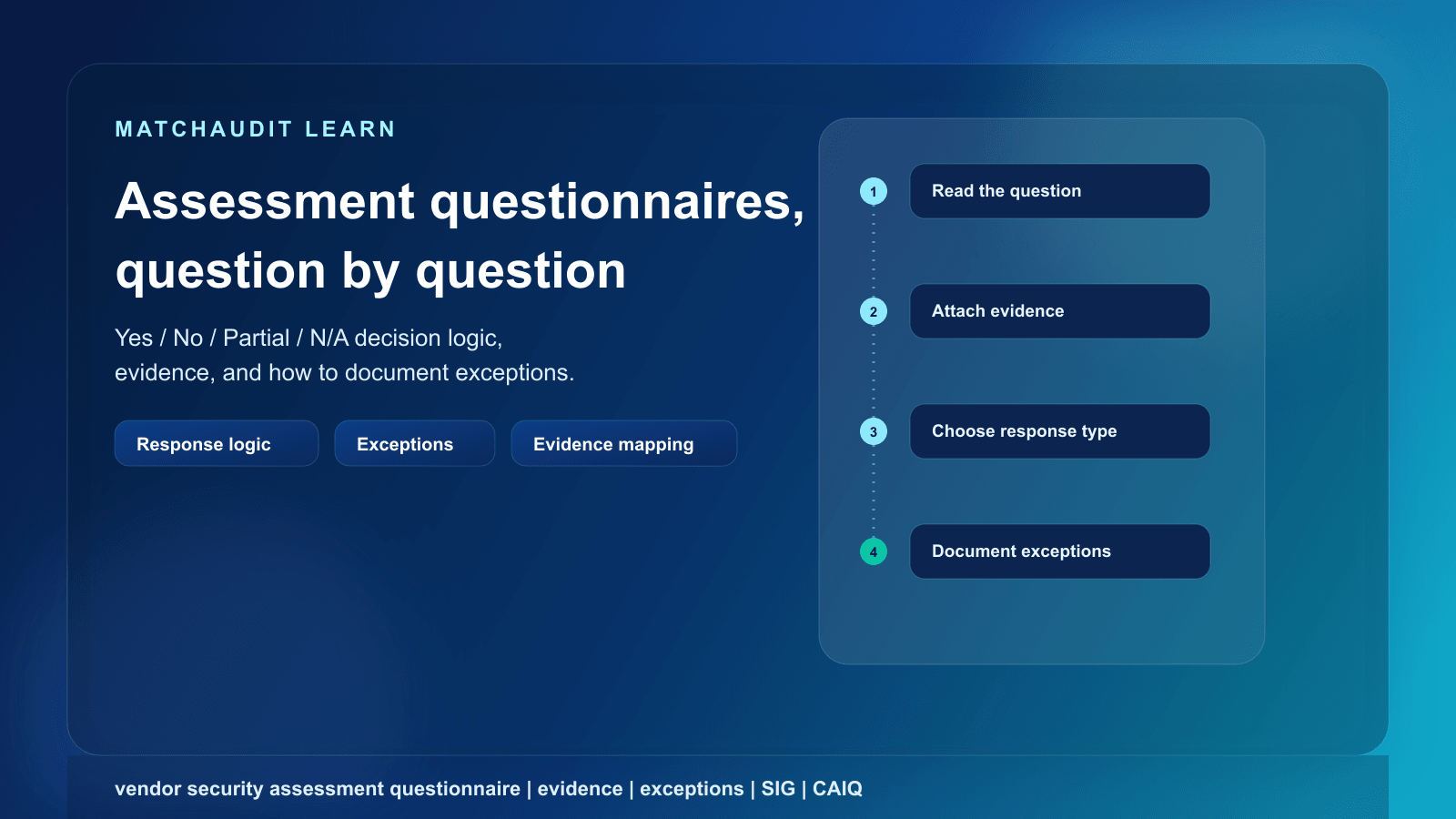
How to answer a vendor security assessment questionnaire: common question categories, what evidence to attach, when to use Yes/No/Partial/N/A, and how to document exceptions honestly.
Vendor Security Assessment Questionnaire: Questions, Evidence and How to Respond
Last reviewed: 26 September 2026. This article describes common industry practice; it is not legal advice, and requirements vary by customer, industry, and jurisdiction.
Quick answer
A vendor security assessment questionnaire is a detailed set of questions a customer sends to evaluate a specific vendor's security controls before or during a contract — typically covering access control, data protection, network security, incident response, business continuity, subprocessors, physical security, certifications, and secure development practices. It goes deeper than a short intake form: expect dozens to hundreds of questions, often in Yes/No/Partial/N/A format, each expecting a specific, evidenced answer rather than a general description.
The safest way to respond is: answer only what you can support with evidence, use "Partial" or an exception note when a control is not fully implemented rather than rounding up to "Yes," and attach a specific evidence reference (a policy excerpt, an architecture diagram, a certification summary, or a test attestation) to each claim. Vague or unsupported answers are the most common trigger for a follow-up round of clarifying questions.
Contents
- What is a vendor security assessment questionnaire?
- How it differs from a lighter intake form
- Common question categories
- Evidence that supports each category
- Yes / No / Partial / N/A: how to choose
- Documenting exceptions honestly
- Avoiding overclaiming and underclaiming
- Example questions and answer structure
- Why follow-up questions happen
- FAQ
- Related reading
What is a vendor security assessment questionnaire?
A vendor security assessment questionnaire is a structured document a customer (or its security, procurement, or third-party risk team) sends to a specific vendor to evaluate the controls around a specific product or service. It is typically triggered by a real deal or renewal, is scoped to the service actually being purchased, and asks for specific, checkable answers rather than marketing descriptions.
Assessment questionnaires commonly draw on, or are inspired by, established industry frameworks. Two widely referenced examples:
- SIG (Standardized Information Gathering) is published by Shared Assessments, a membership organization focused on third-party risk management. It is available in different lengths (a shorter "Lite" version and a longer "Core" version) and organizes questions across a broad set of control domains.
- CAIQ (Consensus Assessments Initiative Questionnaire) is published by the Cloud Security Alliance and maps a set of largely Yes/No questions to the CSA's Cloud Controls Matrix, aimed specifically at cloud service providers.
Many customers do not use either framework directly — they write their own questionnaire, often adapted from one of these or from an internal template built up over years. This article describes the common structure and mechanics of responding to any detailed assessment questionnaire; it does not reproduce the specific wording of SIG, CAIQ, or any other named framework.
If your customer sends a named framework (SIG, CAIQ, or an internal equivalent) rather than a free-form document, treat the framework's own instructions and scoring guidance as authoritative — this article covers the general mechanics of responding, not that framework's specific rules.
How this differs from a lighter intake form
A short intake or pre-qualification form usually asks a handful of yes/no questions to decide whether a fuller review is needed at all — for example, "Do you store customer data?" or "Do you hold a current SOC 2 report?" It is meant to be completed in minutes, often before a contract is close to signed.
A full assessment questionnaire is different in scale and purpose:
| Intake form | Assessment questionnaire | |
|---|---|---|
| Typical length | 5–20 questions | 30–300+ questions |
| Timing | Early screening, pre-sale | During due diligence, closer to contract |
| Evidence expected | Usually none, or a certificate name | Specific documents, excerpts, or attestations per answer |
| Outcome | Routes the vendor into (or out of) a deeper review track | Feeds a risk decision, contract conditions, or approval/rejection |
| Owner on the customer side | Sales-adjacent or light procurement check | Security, GRC, or third-party risk team |
If you are preparing general evidence ahead of receiving any specific questionnaire, that pre-readiness work is a separate exercise from responding to one. This article focuses on the second part: answering a live, specific assessment questionnaire question by question.
Common question categories
Assessment questionnaires vary by customer, but most draw from a recognizable set of categories. Categories below are described generically — actual questionnaires vary in wording, depth, and which categories they include.
| Category | What it typically probes |
|---|---|
| Access control | Authentication methods, MFA, privileged access management, least-privilege provisioning, access reviews, offboarding |
| Data protection / encryption | Encryption at rest and in transit, key management, data classification, data retention and deletion |
| Network security | Segmentation, firewalls, intrusion detection/prevention, vulnerability scanning, patch management |
| Incident response | Documented IR plan, detection capability, notification timelines, past incident history, breach communication process |
| Business continuity / disaster recovery | Backup frequency, recovery time/point objectives, DR testing cadence, failover architecture |
| Subprocessors / fourth parties | List of subprocessors, what data they access, how they are assessed, notification of changes |
| Physical security | Data center controls, badge access, environmental controls (often inherited from a cloud/hosting provider rather than owned directly) |
| Compliance / certifications | Relevant certifications or attestations (e.g., SOC 2, ISO 27001), audit scope, exceptions noted in the report |
| Secure SDLC | Secure coding practices, code review, dependency/vulnerability scanning, change management, penetration testing cadence |
Do not assume every questionnaire uses these exact category names or this exact grouping. Read each customer's questionnaire on its own terms — some combine categories, some split them further, and some add categories specific to their industry (e.g., payment data handling, model governance for AI-enabled features).
Evidence that supports each category
A confident-sounding answer without a linked source is exactly what a reviewer is trained to flag. Typical evidence types by category:
| Category | Supporting evidence examples |
|---|---|
| Access control | Access control policy excerpt, MFA enforcement screenshot/config summary, access review log or attestation |
| Data protection / encryption | Encryption standard/policy excerpt, key management summary, data classification policy |
| Network security | Network architecture diagram, vulnerability scan summary, patch management policy |
| Incident response | Incident response plan excerpt, notification SLA/timeline documentation, tabletop exercise summary |
| Business continuity / DR | BC/DR policy, RTO/RPO statement, most recent DR test summary |
| Subprocessors | Current subprocessor list with data-access description, subprocessor assessment/contract summary |
| Physical security | Hosting provider's own compliance summary (e.g., cloud provider's data center certifications) |
| Compliance / certifications | Certification/attestation summary, scope statement, and a summary of any noted exceptions |
| Secure SDLC | Secure development policy excerpt, pen test attestation letter, dependency-scanning tool summary |
Every answer should be traceable to a specific document or fact, not typed from memory.
Yes / No / Partial / N/A: how to choose
Most assessment questionnaires constrain answers to a fixed set of options. Choosing the wrong one is one of the most common ways vendors either undersell themselves or create risk they didn't intend.
| Response | Use when | Risk of misusing it |
|---|---|---|
| Yes | The control is fully implemented, in production, and you can point to specific evidence covering the exact scope asked | Answering "Yes" without evidence, or when the control only partially covers the asked scope, is the single biggest source of contract and audit risk — it can read as a misrepresentation later |
| No | The control genuinely does not exist, or is not applicable in the way the question assumes and no compensating measure exists | Answering "No" when a compensating or equivalent control exists can needlessly cost you the deal or trigger unnecessary escalation |
| Partial | The control exists but doesn't fully cover the question's scope — e.g., MFA is enforced for admins but not yet for all users, or encryption is in place except for one legacy component | Using "Partial" as a vague hedge without explaining exactly what is and isn't covered undersells you and invites a follow-up round anyway — always pair it with a specific scope note |
| N/A | The question does not apply to your product or architecture — e.g., a physical-security question when you have no physical offices handling customer data, or a subprocessor question when you use none | Marking "N/A" without a one-line justification looks evasive and is a common trigger for a clarifying question — always state why it doesn't apply |
"Partial" and "N/A" are not softer versions of "No." Used correctly with a clear explanation, they are often the most accurate and most credible answer — reviewers generally trust specific, scoped answers more than a blanket "Yes" with no detail.
Documenting exceptions honestly
An exception is any point where a control doesn't fully match what's asked — not fully implemented, implemented differently than expected, or covered by a compensating control instead of the one named in the question. Documenting it well is usually better received than avoiding the topic.
A simple exception-documentation template:
| Field | What to include |
|---|---|
| Control/question referenced | The specific question or control number the exception relates to |
| Current state | A factual, specific description of what is actually in place today |
| Gap | What is missing relative to what was asked |
| Compensating control (if any) | Any control that reduces the risk in the meantime (e.g., manual review process while an automated one is built) |
| Remediation plan and target date | What is planned, and a realistic date — only commit to dates you can meet |
| Owner | Who internally is accountable for closing the gap |
Keep the tone factual rather than defensive. Reviewers who assess many vendors are generally more comfortable with a clearly scoped exception and a credible remediation date than with a suspiciously perfect set of "Yes" answers across every question.
Avoiding overclaiming and underclaiming
Two opposite failure modes cause different kinds of damage:
- Overclaiming — answering "Yes" to something you cannot evidence, or answering at a broader scope than what is actually true. This can surface later during a deeper review, an audit, an incident, or a renewal — and a discovered overclaim tends to damage trust in every other answer you gave, not just the one in question.
- Underclaiming — answering "No" or leaving detail out for something you actually do well, often because the person completing the questionnaire didn't know the control existed or couldn't find the evidence quickly. This can cost you the deal or trigger unnecessary escalation for no real risk reason.
The practical fix for both is the same: never answer a question you can't trace to a specific, current piece of evidence. If you're not sure whether a control fully covers what's asked, that uncertainty itself is information — reflect it as "Partial" with a scope note rather than rounding in either direction.
Example questions and answer structure
The questions below are illustrative, generic examples written for this article — they are not reproduced from any specific vendor's or framework's proprietary questionnaire.
| Example question (illustrative) | Category | Answer structure |
|---|---|---|
| "Do you encrypt data at rest?" | Data protection | Claim (what's encrypted and with what standard) → evidence reference (encryption policy excerpt or architecture summary) → scope/limitation (e.g., any component or data store not yet covered) |
| "Describe your incident response process and customer notification timelines." | Incident response | Claim (that a documented IR process exists, with a notification-timeline commitment) → evidence reference (IR plan excerpt, SLA documentation) → scope/limitation (e.g., timelines vary by severity classification) |
| "List your subprocessors and describe what data each can access." | Subprocessors | Claim (current subprocessor list exists and is maintained) → evidence reference (subprocessor list document) → scope/limitation (e.g., notice period for adding a new subprocessor) |
| "Is multi-factor authentication enforced for all users with access to customer data?" | Access control | Claim (MFA enforcement status) → evidence reference (access control policy excerpt or MFA configuration summary) → scope/limitation (e.g., enforced for employees, rollout in progress for a specific role group) |
| "Do you conduct regular penetration testing?" | Secure SDLC | Claim (testing cadence) → evidence reference (most recent pen test attestation letter) → scope/limitation (e.g., scope of the test, remediation status of findings) |
This claim → evidence → scope structure applies regardless of category: state what's true, point to the specific document or fact that proves it, and note any limitation on scope. A structure like this is easier to defend under follow-up questioning than a one-line "Yes" ever is.
Why follow-up questions happen
Reviewers on the customer side are typically trained to probe answers that are vague, unsupported, or inconsistent with other parts of the questionnaire or with attached evidence. A follow-up round is a normal part of the process, not necessarily a sign that something is wrong — common triggers include:
- An answer of "Yes" or "Partial" with no evidence reference attached
- A "Partial" or "N/A" answer without an explanation of scope or applicability
- An answer that appears to conflict with a certification report, a diagram, or another questionnaire response
- A question about scope the reviewer needs clarified before they can assess risk (e.g., which environments or data types a control actually covers)
Answering thoroughly and specifically the first time — with evidence attached rather than promised later — is the most reliable way to reduce the number of follow-up rounds, though it rarely eliminates them entirely for higher-risk deals.
How MatchAudit fits in
Assessment questionnaires get harder to answer well when evidence and past answers are scattered across shared drives, email threads, and different people's memory. MatchAudit's Vendor Assurance workspace lets a vendor upload and version reusable evidence documents and record reusable structured facts, each reviewed and approved by a human. When a new customer questionnaire comes in, MatchAudit uses AI to extract requirement candidates (with the source excerpt and a confidence indicator) for a human to review, and lets you answer each requirement by linking to your approved facts and documents as sources, with an AI-suggested draft that a human must still approve before anything goes out. Approved responses can be exported as a report only after that approval step — the goal is that every answer stays traceable to its source instead of being retyped from memory each time.
FAQ
Is a vendor security assessment questionnaire the same as a SIG or CAIQ questionnaire? Not necessarily. SIG (published by Shared Assessments) and CAIQ (published by the Cloud Security Alliance) are two well-known published frameworks that some customers use directly. Many customers instead write their own questionnaire, sometimes adapted from these frameworks. The mechanics of responding — evidence, response format, exceptions — apply regardless of which one you receive.
How long does it typically take to complete one? It depends heavily on length, how much current evidence you already have organized, and how many internal teams need to contribute an answer. A short, well-prepared vendor with organized evidence can move faster than one starting from scratch for every question.
Should I ever answer "Yes" without attached evidence to save time? No. An unsupported "Yes" is one of the most common causes of a follow-up request, and if discovered later during a deeper review or after an incident, it can damage trust in every other answer you provided.
What if a question doesn't clearly apply to our product? Mark it "N/A" and add a short, specific reason why it doesn't apply. An unexplained "N/A" is often read as evasive and tends to generate a clarifying question anyway.
Can AI complete these questionnaires automatically? AI can help extract requirements from a questionnaire, suggest which existing evidence or facts are relevant, and draft an initial answer. It should not replace human review — final answers should be approved by someone accountable for their accuracy, particularly for questions involving scope interpretation or risk judgment.
Do we need to disclose a control that isn't fully implemented? Generally yes, if the question asks about it directly. A well-documented exception with a compensating control or realistic remediation date is typically viewed more favorably than an answer that later turns out to be inaccurate.
How is this different from preparing evidence before any questionnaire arrives? Pre-readiness work (organizing evidence and identifying gaps before a specific customer questionnaire exists) is a separate, earlier step. This article covers responding to a specific, live questionnaire question by question, once it's in front of you.
Related reading
- Vendor onboarding: the full lifecycle from first ask to approval
- Security questionnaires: what they are and why customers send them
- SaaS security questionnaire: preparing before you receive one
Ready to stop retyping the same answers from memory? See how Vendor Assurance works or start organizing your evidence today. Have a specific questionnaire on your desk right now? Talk to us.
Related reading
Security Questionnaire Automation: How to Answer Customer Reviews Faster Without Losing Evidence or Accuracy
A stage-by-stage breakdown of the security questionnaire workflow — intake to reuse — showing exactly where AI automation genuinely helps and where human judgment has to stay.
SaaS Security Questionnaire Checklist: What to Have Ready Before Your First Enterprise Review
A pre-readiness checklist and evidence matrix for SaaS companies facing their first enterprise security questionnaire — what to have on hand, who should own it, and how to answer honestly when you're not ready.