24 Sept 2026
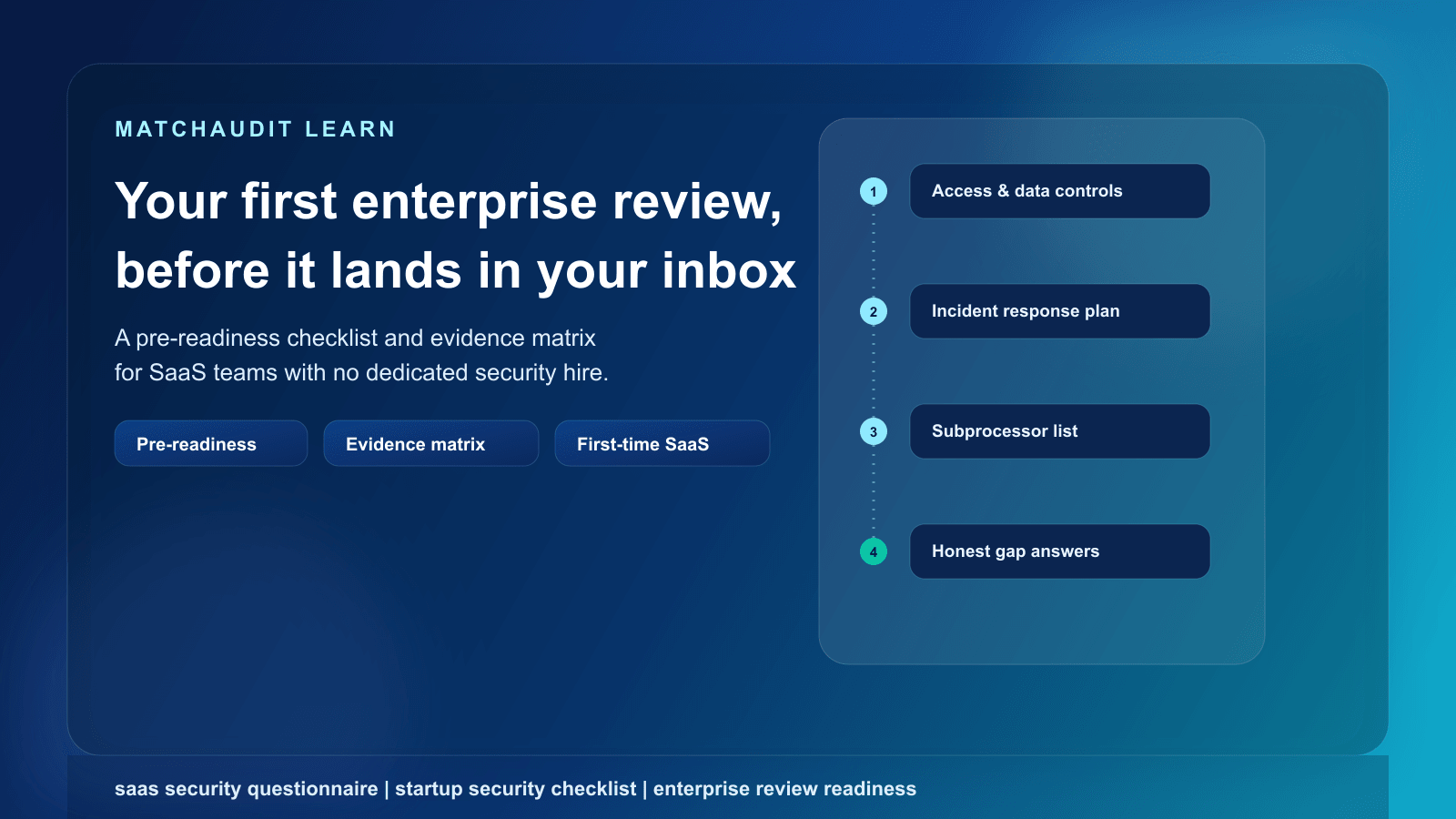
SaaS Security Questionnaire Checklist: What to Have Ready Before Your First Enterprise Review
A pre-readiness checklist and evidence matrix for SaaS companies facing their first enterprise security questionnaire — what to have on hand, who should own it, and how to answer honestly when you're not ready.
SaaS Security Questionnaire Checklist: What to Have Ready Before Your First Enterprise Review
Last reviewed: 24 September 2026. This article describes common industry practice; it is not legal advice, and requirements vary by customer, industry, and jurisdiction.
Quick answer
Before a SaaS company's first enterprise security review, it should have, at minimum: a documented access-control approach (MFA, least privilege, offboarding), a written data-handling and encryption position, a basic incident-response plan, a subprocessor list, an inventory of third-party tools that touch customer data, and a clear owner for security questions. None of this needs to be perfect or certified — early-stage companies rarely have a SOC 2 report yet. What matters is having honest, current answers ready instead of improvising during the questionnaire itself. The rest of this article gives a category-by-category checklist, an evidence matrix, and guidance on what to say when the honest answer is "not yet."
Contents
- Why pre-readiness matters more than the questionnaire itself
- The readiness checklist by category
- Evidence matrix: what gets probed and what to have on hand
- Who owns this at an early-stage SaaS company
- What's realistic on day one vs. built incrementally
- How to answer honestly when you're not ready
- FAQ
- Related reading
Why pre-readiness matters more than the questionnaire itself
Most guidance about security questionnaires focuses on how to answer one that has already landed in your inbox — how to read the questions, who should draft responses, how to speed up turnaround. That is useful, but it assumes the underlying facts already exist: that someone knows whether MFA is enforced, whether there's an incident-response plan, whether a subprocessor list exists.
For a SaaS company going through its first enterprise review, that assumption often doesn't hold. The gap isn't questionnaire-answering skill — it's that half the underlying practices were never written down, and some were never decided at all.
This article is about what to have in place before a questionnaire arrives, so that answering one becomes a matter of retrieving and adapting existing facts rather than inventing them under deadline pressure. If a questionnaire is already sitting in your inbox, the mechanics of responding to it — mapping questions, drafting answers, handling follow-ups — are covered separately in our security questionnaire hub and vendor security assessment questionnaire guide.
The practical risk of skipping pre-readiness isn't just a slower deal. It's inconsistent or guessed answers making it into a submitted document — which can create bigger problems later than a "not yet" ever would, because a reviewer who later finds a gap between what was claimed and what actually exists treats the whole submission with more suspicion.
The readiness checklist by category
This is a reusable checklist, not a one-time exercise. Review it before the first review, and again as the company grows. Each item below is written as a yes/no fact you should be able to state with confidence — not as a policy you need to have perfectly worded.
Access control
- Multi-factor authentication is enforced on email, cloud infrastructure, source control, and any system holding customer data
- Access follows least privilege — people have access to what their role requires, not broad admin access by default
- A documented process exists for granting access when someone joins and revoking it when someone leaves or changes role
- Privileged/admin accounts are identifiable and their number is small and known
- Password and session policies exist for internal tools (even if informal)
Data handling and encryption
- You can describe what customer data you collect, where it's stored, and why
- Data is encrypted in transit (TLS) and at rest for production data stores
- A data retention and deletion approach exists, even if simple
- You know which environments (production, staging, dev) contain real customer data, if any
Infrastructure and cloud security
- You can name your cloud provider(s), regions, and hosting model
- Production and non-production environments are separated
- Cloud account access is restricted and not tied to personal/shared logins
- Basic logging and monitoring exist for production systems
- A vulnerability or dependency-scanning practice exists, even a lightweight one
Incident response
- A written incident-response plan exists, even a short one: who gets notified, who decides, how customers are informed
- You know who is responsible for security decisions during an incident
- A customer-notification approach exists for data-related incidents (timing, channel, who approves the message)
Business continuity
- Backups exist for critical production data and have been checked, not just configured
- You can describe, at a basic level, how the service would recover from an outage or data-loss event
- Uptime/availability expectations you can honestly stand behind are known internally, even if not formally published
Subprocessors and vendor management
- A list exists of every third-party service that stores or processes customer data (hosting, email, analytics, payments, support tools, AI/LLM providers)
- For each one, you know what data it touches and why it's used
- You've checked whether those vendors have their own security posture you'd need to reference (e.g., their SOC 2, their subprocessor list)
HR and personnel security
- New hires go through some form of background or reference check appropriate to their role and access level
- Employees who leave have access revoked as part of the offboarding process
- Some baseline security awareness exists among staff — even an informal onboarding conversation counts as a starting point
Secure development lifecycle
- Code changes go through review before reaching production (even a simple pull-request approval process)
- Secrets (API keys, credentials) are not committed to source control
- A basic process exists for handling and prioritizing reported vulnerabilities
Physical security (if applicable)
- If you operate any physical office or self-managed hardware handling customer data, basic access controls exist
- Most cloud-native SaaS companies can state that infrastructure is entirely hosted with a major cloud provider and inherits that provider's physical security — say so plainly rather than leaving the question blank
Compliance and certifications
- You know honestly whether you hold any certification (SOC 2, ISO 27001) or are pursuing one, and can state a realistic timeline if you are
- If you hold no certification, you can say so directly and point to the underlying controls instead
- Any applicable regulatory context (e.g., handling health, financial, or payment data) is identified, even if the compliance program around it is still developing
Evidence matrix: what gets probed and what to have on hand
Enterprise reviewers rarely accept a verbal "yes" — they look for an artifact. This matrix maps each category to what a first-time review commonly probes, the artifact that answers it, and a status column you can fill in for your own company.
| Category | Commonly probed | Artifact to have on hand | Status |
|---|---|---|---|
| Access control | MFA enforcement, offboarding process | Screenshot/policy of MFA config; written offboarding checklist | Have it / Partial / Missing |
| Data handling & encryption | Encryption in transit/at rest, data map | Architecture or data-flow diagram; encryption statement from cloud provider | Have it / Partial / Missing |
| Infrastructure & cloud | Environment separation, cloud provider security | Cloud architecture diagram; provider's own compliance page/cert | Have it / Partial / Missing |
| Incident response | Existence of a plan, notification timing | Written incident-response plan (1–2 pages is fine) | Have it / Partial / Missing |
| Business continuity | Backup frequency, recovery approach | Backup configuration + last restore-test evidence | Have it / Partial / Missing |
| Subprocessors | Full list of data-touching vendors | Subprocessor list with purpose per vendor | Have it / Partial / Missing |
| HR / personnel | Background checks, offboarding | Onboarding/offboarding checklist; hiring policy note | Have it / Partial / Missing |
| Secure development | Code review, secrets management | Pull-request policy; confirmation secrets aren't in source control | Have it / Partial / Missing |
| Physical security | Office or hosting physical controls | Statement of cloud-only infrastructure, or office access policy | Have it / Partial / Missing |
| Compliance / certifications | SOC 2, ISO 27001, roadmap | Certificate/report, or honest "in progress" statement with target date | Have it / Partial / Missing |
An artifact that exists but is out of date (an incident-response plan no one has read in a year, a subprocessor list missing a tool added last month) is functionally closer to "missing" than "have it." Treat staleness as its own gap, not a rounding error.
Filling in the "Status" column honestly — before a questionnaire arrives — is the single highest-leverage exercise in this article. It turns an abstract fear ("we're not ready for enterprise security review") into a short, specific list of what to build next.
Who owns this at an early-stage SaaS company
Most early-stage SaaS companies don't have a dedicated security hire when the first enterprise questionnaire arrives. That's normal, and it doesn't mean the work can't happen — it means ownership needs to be assigned deliberately rather than left to whoever answers the email first.
Common ownership patterns at this stage:
- A technical co-founder or engineering lead usually owns infrastructure, access control, and secure-development answers, since they can speak to what's actually configured.
- Whoever owns operations or people/HR typically owns personnel-security answers (onboarding, offboarding, background checks) and vendor/subprocessor tracking.
- Sales or customer-facing leadership often ends up coordinating the questionnaire itself — routing questions to the right internal person and keeping the deal moving — without necessarily writing the technical answers themselves.
- Someone should be named as the single point of contact for security questions, even part-time, so answers don't fragment across founders answering the same question differently in different deals.
This does not require a security title or a full-time role. It requires one person who can say, credibly, "I know the current state of our access control, our incident plan, and our vendor list, and I'll tell you honestly if something isn't in place yet."
What's realistic on day one vs. what can be built incrementally
Not every item in the checklist above needs to exist before the first customer conversation. A reasonable triage:
Reasonable to have from day one, regardless of company size:
- MFA enforced on core systems
- A basic offboarding step (revoke access when someone leaves)
- Knowledge of what third-party tools touch customer data
- Encryption in transit and at rest (usually the default with a modern cloud provider, but confirm it)
- Honesty about what you don't have yet
Reasonable to build in the weeks around the first review, once a deal makes it concrete:
- A written (even short) incident-response plan
- A formal subprocessor list document, rather than tribal knowledge
- A basic access-review or least-privilege pass
- A compliance roadmap statement, if pursuing SOC 2 or similar
Reasonable to treat as a longer-term build, not a blocker for a first deal:
- A completed SOC 2 Type II report (these take months and typically require a period of operating under the controls first)
- Formal, tested business-continuity exercises
- A dedicated security function or hire
The mistake to avoid is either extreme: pretending everything is already in place, or concluding that because a full program doesn't exist, no enterprise deal can proceed. Reviewers on the other side of a first-time SaaS vendor's questionnaire generally expect a smaller company's controls to be less mature than a large vendor's — what they're checking for is whether the answers are honest, specific, and proportionate to the risk of the data involved.
How to answer honestly when you're not ready
Every SaaS company doing its first enterprise review will hit a question it can't fully answer. How that moment is handled matters more than most of the checklist above.
Three honest response patterns, instead of guessing:
- "In progress" with specifics. Not just "we're working on it" — state what's in place today, what's planned, and a realistic timeframe if you have one. "We do not yet hold SOC 2, we plan to begin the audit period in Q1" is a usable answer. A vague "coming soon" is not.
- "Not applicable" with a reason. If a question genuinely doesn't apply to your architecture (for example, a physical-security question for a company with no offices or self-hosted hardware), say so and explain why, rather than leaving it blank or answering as if it applied.
- "We don't have that control at this scope" stated plainly. For a genuine gap with no immediate plan, say so directly. A reviewer can factor a known, disclosed gap into a risk decision. They generally cannot factor in a gap they discover later that was implied to not exist.
A guessed or overstated answer doesn't remove the risk a reviewer is trying to assess — it just delays when they find out, usually at a worse moment than the first review.
What to avoid regardless of pressure to close the deal:
- Answering "yes" to a control question because the honest answer would slow things down
- Copying an answer from a template or a previous deal without checking it's still true for this one
- Leaving a question blank rather than stating "not applicable" or "in progress"
- Claiming a certification is "in progress" with no real plan or timeline behind it
This is also where having evidence organized in one place pays off beyond the first deal. Once a SaaS company has been through a few reviews, the same evidence — the incident-response plan, the subprocessor list, the access-control description — gets asked for again by the next customer, and again after that. MatchAudit's Vendor Assurance workspace is built around that reuse problem specifically for the vendor side: it lets a company upload and version its evidence documents once, record approved facts about its controls, and see a per-customer readiness view of what's missing, expired, or due for review before the next questionnaire lands — rather than rebuilding the same answers from scratch or hunting through old email threads each time. It doesn't decide what your controls are or answer questions for you; a human still approves every fact, document link, and drafted answer before it goes out.
FAQ
Do we need SOC 2 before our first enterprise customer will sign?
Not necessarily. Many enterprise buyers will proceed with a smaller vendor that doesn't yet hold SOC 2 or ISO 27001, provided the underlying controls are reasonable for the data involved and the company is honest about its compliance roadmap. Some buyers do require certification for higher-risk data or larger contracts — this varies by customer, industry, and the sensitivity of what you'd be handling.
What's the single most common thing early-stage SaaS companies are missing?
Based on the categories most frequently probed, it's usually a combination of an out-of-date or nonexistent subprocessor list and no written incident-response plan — both are quick to produce once someone sits down to write them, but are easy to overlook until a questionnaire asks for them directly.
Who should fill out a security questionnaire at a company with no security team?
Whoever can speak most credibly to each section: usually a technical co-founder or engineering lead for infrastructure and access-control questions, and an operations or people lead for personnel and vendor-management questions. One person should coordinate the overall response even if several people contribute answers.
How long does it realistically take to get "ready" for a first enterprise review?
It depends heavily on current state, but a company starting from zero can typically produce the core artifacts in this checklist — access-control description, incident-response plan, subprocessor list, encryption statement — within a few weeks of focused effort, since most of it is documentation of existing practice rather than new engineering work.
Should we say "not applicable" or just skip a question we don't think applies?
Say "not applicable" and give a short reason. A skipped question reads as an oversight or an evasion; a stated "not applicable, because..." reads as an informed answer, even when the underlying fact is the same.
Is this checklist the same as answering a live questionnaire?
No. This checklist is about the state a SaaS company should be in before a questionnaire arrives, so that answering one is a matter of retrieving existing facts. The mechanics of responding to a specific, already-received questionnaire — mapping its questions, drafting per-question answers, handling follow-ups — are a separate exercise covered in our vendor security assessment questionnaire guide.
What happens if we get a question about a framework we've never heard of (SIG, CAIQ, NIST)?
Treat it the same as any other question you're not ready for: identify what it's actually asking underneath the framework name (most map back to the same categories in this checklist — access control, encryption, incident response, and so on), answer honestly based on your actual controls, and don't claim familiarity with a framework you haven't reviewed.
Related reading
- Security Questionnaire: The Complete Hub — broad overview of what security questionnaires are, common formats, and how the response process generally works
- Vendor Onboarding: The Full Lifecycle Guide — how questionnaire readiness fits into the broader customer onboarding and due-diligence lifecycle
- Vendor Security Assessment Questionnaire Guide — question-by-question mechanics for responding once a live questionnaire has arrived
Ready to see exactly where your evidence stands before the next questionnaire arrives? Run a readiness check against your first enterprise deal, or talk to us about organizing your evidence before it's requested. See pricing for plan details.
Related reading
Security Questionnaire Automation: How to Answer Customer Reviews Faster Without Losing Evidence or Accuracy
A stage-by-stage breakdown of the security questionnaire workflow — intake to reuse — showing exactly where AI automation genuinely helps and where human judgment has to stay.
Vendor Security Assessment Questionnaire: Questions, Evidence and How to Respond
How to answer a vendor security assessment questionnaire: common question categories, what evidence to attach, when to use Yes/No/Partial/N/A, and how to document exceptions honestly.