DORA Article 30 Contract Requirements: A Supplier's Clause-by-Clause Guide | MatchAudit Learn
DORA Article 30 Contract Requirements: A Supplier's Clause-by-Clause Guide
Your bank customer sent a DORA addendum. What Article 30 requires in ICT contracts, which clauses apply only to critical or important functions, and how to prepare.
•11 min read
DORA Article 30 sets the minimum content of every contract between an EU financial entity and its ICT service providers. If you supply software, data, hosting, IT support or another ICT service to a bank, payment institution, insurer or other DORA entity, this is why you received a "DORA addendum". All ICT contracts must cover nine points, such as service description, data locations, incident assistance and termination. Contracts for services that support a critical or important function must also cover six more: precise service levels, business continuity testing, threat-led penetration testing, audit rights and an exit transition period.
DORA (Regulation (EU) 2022/2554) places these duties on the financial entity, not on you. They reach you through the contract. Article 30(1) also requires the whole agreement, including the service levels, to sit in one written document, on paper or in a durable, downloadable format. That is why many customers send one consolidated addendum rather than a list of questions.
This guide explains each requirement in plain language, what it usually means for a mid-size supplier, and what to have ready before the addendum arrives. It is not legal advice. Have the final wording reviewed by your own counsel.
Does Article 30 apply to my company?
Article 30 applies to contracts for ICT services. DORA defines ICT services broadly: digital and data services provided through ICT systems to users on an ongoing basis, including hardware as a service and hardware technical support, but excluding traditional analogue telephone services. SaaS, cloud hosting, managed IT, data feeds, software maintenance and many outsourced operations fall within it.
You are not directly regulated by DORA unless the European Supervisory Authorities have designated you a critical ICT third-party provider. The first list, published on 18 November 2025, named 19 providers, mostly large cloud, software and infrastructure groups. For everyone else, DORA works through the customer. Your customer must not sign an ICT contract that lacks the Article 30 content, so in practice the clauses are non-negotiable in substance. What you can negotiate is the detail: notice periods, cost of assistance, audit logistics and how exit works.
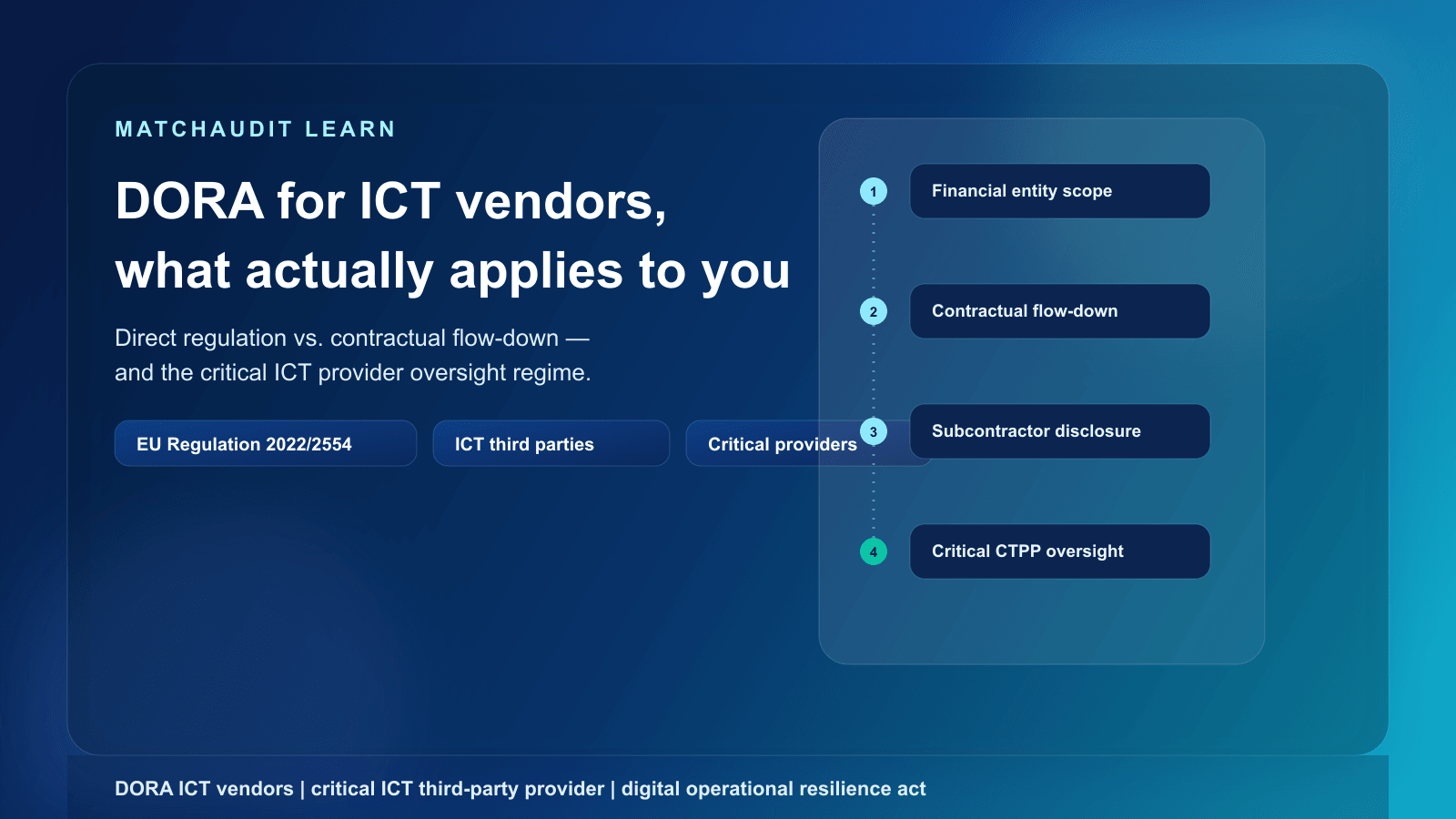
For the broader picture of how DORA reaches suppliers, read DORA for ICT vendors.
The two tiers: all ICT contracts vs critical or important functions
The single most important question in a DORA addendum is whether your customer classifies your service as supporting a . DORA defines this as a function whose disruption would materially impair the entity's financial performance, the soundness or continuity of its services, or its compliance with its licence conditions.
Your customer makes this call, based on its own business impact analysis. Two suppliers selling the same product can get different answers from different banks. Ask your customer early which tier applies. It decides whether you are looking at nine contract requirements or fifteen, and whether audit, penetration-testing and exit obligations apply.
The classification also feeds your customer's DORA register of information, so expect the same answer to come back in the annual data request.
The nine clauses every ICT contract must contain (Article 30(2))
Point
What the contract must cover
What it usually means for you
(a)
A clear, complete description of all functions and ICT services, and whether subcontracting of a critical or important function is allowed, and on what conditions
An accurate service description and a current subcontractor list. Vague "platform services" wording no longer works.
(b)
Locations (regions or countries) where services are provided and data is processed and stored, and a duty to notify the customer in advance of a planned change
A data-location statement per service, and a change-notification process you can actually operate.
(c)
Availability, authenticity, integrity and confidentiality of data, including personal data
Security commitments, usually by reference to your security schedule and data processing agreement.
(d)
Access, recovery and return of personal and non-personal data in an easily accessible format if you become insolvent, are resolved, stop operating, or the contract ends
A documented export format and a data-return procedure, including for the insolvency case.
(e)
Service level descriptions, including updates and revisions
An SLA document that is part of the contract, with a change process.
(f)
Assistance with ICT incidents related to your service, at no additional cost or at a cost fixed in advance
A price for incident support, set now. Open-ended "time and materials" is not enough.
(g)
Full cooperation with the customer's competent and resolution authorities, including persons they appoint
A commitment to respond to supervisors. Decide in advance who handles such requests.
(h)
Termination rights and minimum notice periods that meet supervisory expectations
Customer termination rights beyond your standard terms (see Article 28(7) below).
(i)
Conditions for your participation in the customer's ICT security awareness programmes and digital operational resilience training
Occasional participation in customer training. Agree format and frequency.
The six extra clauses for critical or important functions (Article 30(3))
Point
What the contract must add
What it usually means for you
(a)
Full service level descriptions with precise quantitative and qualitative performance targets, so the customer can monitor and act without undue delay
Measurable SLAs (availability, response and resolution times) and regular reporting against them.
(b)
Notice periods and reporting duties, including notice of any development that may materially affect your ability to deliver the agreed service levels
An obligation to warn the customer early: key staff loss, financial distress, a major subcontractor change, a security weakness.
(c)
Requirements to implement and test business contingency plans, and to have appropriate ICT security measures, tools and policies
A tested business continuity and disaster recovery plan, with test evidence you can share.
(d)
Participation and full cooperation in the customer's threat-led penetration testing (TLPT) under Articles 26 and 27
Possible inclusion of your service in the customer's TLPT. Only some financial entities are required to run TLPT, but the clause appears in many addenda.
(e)
Unrestricted rights of access, inspection and audit for the customer, a third party it appoints and its competent authority; the right to take copies of relevant documents on site; the right to agree alternative assurance levels where other clients' rights are affected; full cooperation in inspections; and details of the scope, procedures and frequency of audits
The most negotiated clause. You cannot refuse audit rights, but you can agree how audits run: notice, scope, pooled audits and reliance on independent reports such as ISO 27001 or SOC 2.
(f)
Exit strategies with a mandatory adequate transition period, during which you keep providing the service and the customer can migrate to another provider or in-house
A transition-assistance clause with a period, a price and a data-handover plan.
Article 30(3) also lets a financial entity that is a microenterprise delegate its audit rights to an independent third party you appoint. Most bank customers are not microenterprises, so expect direct audit rights.
Termination and exit: Article 28 behind the addendum
Two parts of Article 28 explain clauses that often surprise suppliers.
Article 28(7) termination rights. The customer must be able to terminate where:
you significantly breach applicable laws, regulations or contract terms;
its monitoring identifies circumstances that could alter your performance, including material changes affecting the arrangement or your situation;
you show weaknesses in your overall ICT risk management, in particular in protecting the availability, authenticity, integrity and confidentiality of data; or
its competent authority can no longer effectively supervise the customer because of the contract or related circumstances.
Article 28(8) exit strategies. For critical or important functions the customer needs a documented, tested exit plan that lets it leave without disrupting its business, its compliance or its own clients. It will ask you for what that plan needs: data export formats, migration support and a realistic transition period.
Subcontractors: what the 2025 RTS adds
Commission Delegated Regulation (EU) 2025/532 specifies what a financial entity must assess when ICT services supporting critical or important functions are subcontracted. It was published in the Official Journal on 2 July 2025. For suppliers it typically leads to contract terms that:
state which parts of the service may be subcontracted and on what conditions;
require you to assess and monitor your own subcontractors and pass relevant obligations down the chain;
require advance notice of material changes to subcontracting, such as a new subcontractor for a critical function or a change of location, with a period for the customer to assess it;
give the customer the right to object to such a change and, in defined cases, to terminate.
Commentary on the adopted text notes that a broader draft article on monitoring the entire subcontracting chain was not kept. Check the final text before accepting clauses based on earlier drafts.
What you can negotiate, and what you cannot
You cannot remove an Article 30 element from a contract with a DORA entity. Their supervisor expects to see it. You can usually negotiate:
Audit logistics: notice periods, frequency, on-site vs remote, pooled audits with other customers, and reliance on certifications as a first step.
Cost: a fixed price for incident assistance and exit support, agreed in advance as Article 30(2)(f) allows.
Notice mechanics: how and when you notify location or subcontractor changes, and through which channel.
Exit period length and the service levels during transition.
Scope: applying the critical-or-important tier only to the services that actually support such a function.
Article 30(4) asks both parties to consider standard contractual clauses developed by public authorities for specific services. Where such clauses exist for your service, offering them can shorten negotiation.
A preparation checklist before the addendum arrives
A service description per service you sell to financial customers.
A current subcontractor list with the services they support and their locations.
A data-location statement: where data is processed and stored, per service.
Your security schedule and data processing agreement.
A data-return and export procedure, including the insolvency case.
An SLA document with measurable targets and a reporting cadence.
Your business continuity and disaster recovery plan, with the date and result of the last test.
Your incident-assistance terms and price.
An audit policy: how you handle customer and supervisor audits, and which independent reports you can share.
An exit-support offer: transition period, migration help and price.
A named owner for regulator requests and change notifications.
A record of which customers classify you as critical or important, and which clause set each one signed.
Most of this is the same evidence your customers ask for in vendor due diligence and bank onboarding reviews. Keeping it current in one place means each new addendum is a review, not a project.
After signing: the addendum becomes obligations
Signing the addendum is the start, not the end. Each clause turns into something your team must do: notify location changes before they happen, report SLA performance, test the continuity plan, support audits and share results. Suppliers with ten bank customers can end up with ten slightly different sets of deadlines.
MatchAudit Customer Assurance is built for this part of the work. You can upload a signed DORA appendix, SLA or security schedule. AI proposes each obligation with the clause reference and a verbatim excerpt, and you assign an owner and due date to the ones you confirm. The same workspace keeps the evidence you reuse across customers, such as the subcontractor list, data-location statement and test results, with a per-customer view of what is ready and what is missing. It helps you keep what your contracts say. It does not interpret them, give legal advice or make anyone DORA compliant. See the product overview or a sample response pack.
Frequently asked questions
What is DORA Article 30?
Article 30 of the Digital Operational Resilience Act lists the key provisions that contracts between EU financial entities and ICT third-party service providers must contain. Paragraph 2 applies to all ICT contracts; paragraph 3 adds requirements for services supporting critical or important functions.
Do I have to sign my customer's DORA addendum?
DORA does not oblige you directly unless you are a designated critical ICT third-party provider. But your customer may not use an ICT service under a contract that lacks the Article 30 content, so refusing the substance usually means losing the contract. The wording, notice periods, costs and audit logistics are negotiable.
What is a critical or important function under DORA?
It is a function whose disruption would materially impair a financial entity's financial performance, the soundness or continuity of its services, or its compliance with its authorisation conditions. The financial entity decides whether your service supports one.
Can I charge for DORA incident assistance?
Yes. Article 30(2)(f) requires assistance with ICT incidents related to your service either at no additional cost or at a cost determined in advance. Agree the price in the contract.
Do DORA audit rights mean any customer can audit us at any time?
For critical or important functions the contract must give the customer, its appointed auditors and its supervisor unrestricted rights of access, inspection and audit. Those rights cannot be contracted away, but you can agree notice, scope, frequency and pooled audits, and alternative assurance levels where other clients' rights are affected.
What does DORA require about subcontractors?
The contract must say whether subcontracting of critical or important functions is permitted and on what conditions. Delegated Regulation (EU) 2025/532 adds what the financial entity must assess, including advance notice of material subcontracting changes and the right to object or terminate.
Researched 28 November 2026 against the published text of Regulation (EU) 2022/2554, Articles 28 and 30, and Delegated Regulation (EU) 2025/532. This is general information, not legal advice. Your contract obligations depend on your service, your customer's classification and the final wording you agree.
Official sources
Regulation (EU) 2022/2554 (DORA), full text: EUR-Lex
Commission Delegated Regulation (EU) 2025/532 on subcontracting ICT services supporting critical or important functions: EUR-Lex
European Supervisory Authorities, designation of critical ICT third-party providers (18 November 2025): EBA
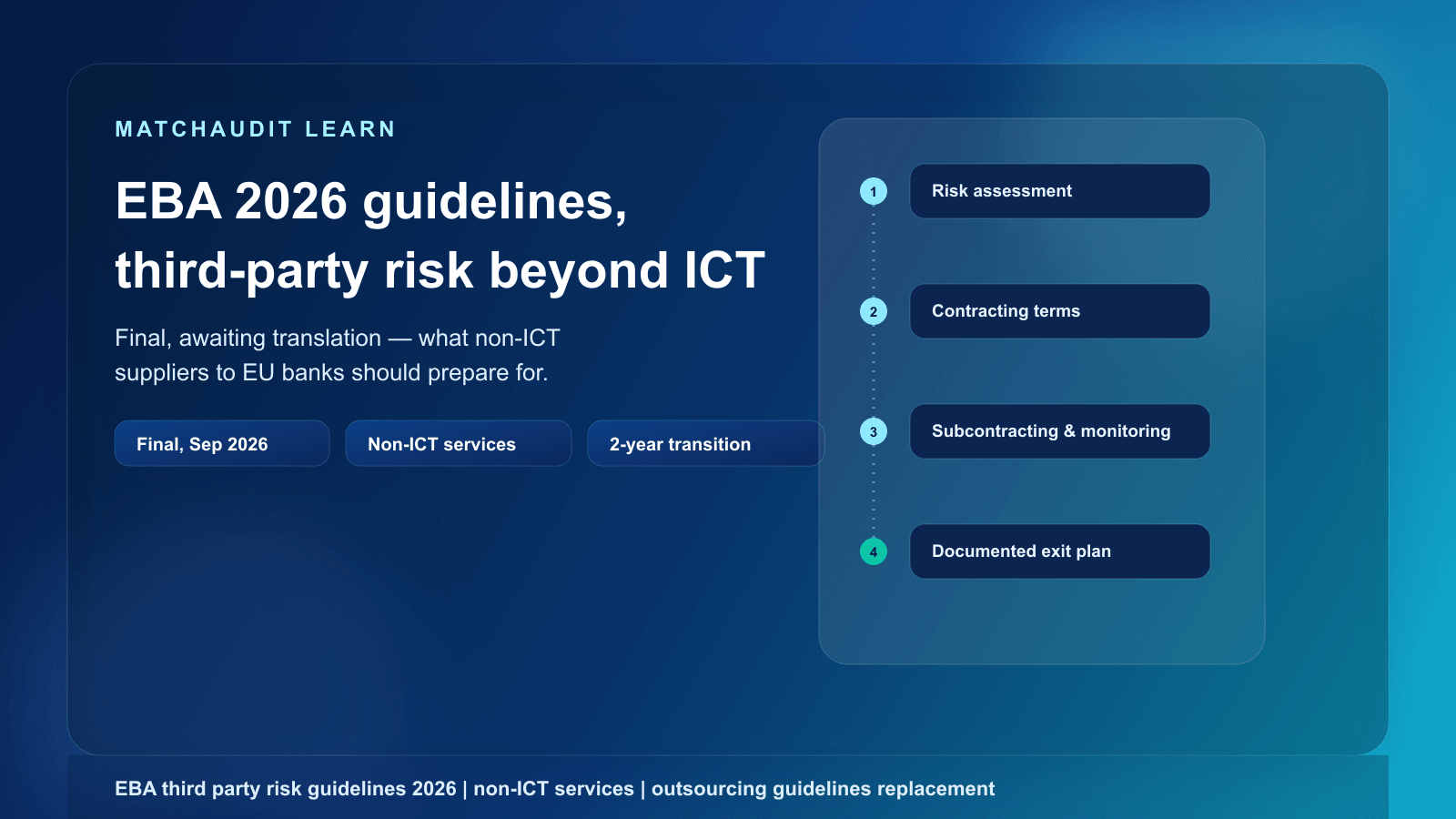
The EBA's final 2026 guidelines on the sound management of third-party risk extend DORA-like principles to non-ICT services. Current status, scope, transitional timeline, and what suppliers should prepare.