Denied Party Screening in the UK and EU: A Guide for Online Stores | MatchAudit Learn
Denied Party Screening in the UK and EU: A Guide for Online Stores
Denied party screening in the UK and EU for online stores: the UK Sanctions List, the EU consolidated list, national lists, when US lists still matter.
•5 min read
For a UK or EU online store, denied party screening means checking each order against the UK Sanctions List, the EU consolidated financial sanctions list and any national lists that apply. Add US lists if you are paid or ship in ways that bring US rules into play. Neither the UK nor the EU prescribes a particular screening method. Both prohibit dealing with listed parties, and screening is how you avoid it and show you took care.
This guide covers denied party screening in the UK and EU: which lists to use, what changed in the UK in 2026 and when US lists still matter. It also covers how to run the check and what to keep. For the general process, see the complete guide to denied party screening. For the wider sanctions rules on online shops, including Russia goods restrictions, read EU and UK sanctions rules for online shops.
Denied party screening in the UK
Use the UK Sanctions List. The Foreign, Commonwealth and Development Office publishes it. Since 28 January 2026 it has been the only source of UK sanctions designations. The former OFSI Consolidated List has closed.
If your screening tool, internal policy or supplier questionnaire still refers to the OFSI Consolidated List, update it:
confirm with your tool provider that it now loads the UK Sanctions List data;
update the list name in your written screening policy;
record the date you switched, so older records still make sense.
UK financial sanctions generally prohibit dealing with funds or economic resources of designated persons and making them available to designated persons. That applies whether you sell to a consumer or a business. UK sanctions also include trade measures by destination and product, which a party check alone does not settle.
Denied party screening in the EU
Use the EU consolidated financial sanctions list. It contains the persons, groups and entities subject to EU financial sanctions. EU law prohibits making funds or economic resources available to them, directly or indirectly. The EU Sanctions Map gives an overview of regimes and measures.
Add national lists where relevant. Some member states publish national sanctions or terrorism lists that go beyond the EU list. Examples include France, the Netherlands, Belgium, Poland and the Baltic states. If you are established in or sell from one of them, check whether its national list applies to you.
EU sanctions are set at EU level, but each member state enforces them and sets its own penalties. Your national authority's guidance is the place to check what is expected locally.
Ownership and control matter. EU restrictions can extend to entities owned or controlled by listed persons, even if those entities are not listed. The guide on the EU 50% ownership and control rule explains the test.
When US lists still matter for UK and EU stores
US rules bind US persons, but they can reach non-US businesses in several ways:
you are paid in US dollars, or through US banks or payment processors;
you sell US-origin goods, or goods with US content or technology, which US reexport rules can cover;
a US person owns, manages or works in your business;
your bank, payment provider or business customers ask for OFAC screening.
In those cases, add the OFAC lists and, for export-controlled goods, US lists such as the BIS Entity List. OFAC check for online orders explains when a store needs one. The lists guide shows how to choose the full set.
How to run the check
Screen every party. Check the customer, billing name, shipping recipient and company name, and the destination region. A listed person can use an address anywhere, so a domestic UK or EU address does not settle the question.
Screen at the right time. Run the check on order creation, hold fulfillment on a potential match and re-screen when details or lists change.
Handle matches in four steps. Hold, review against the full entry, decide and record. If you cannot rule out a match, do not ship. If a match is confirmed, get legal advice before you refund or contact the customer. UK and EU regimes have reporting obligations in some cases, and the steps depend on the facts. For near-matches, use the guide on preventing false positives.
What evidence to keep
Keep, for each order: the data screened, the lists and versions used, any potential matches, the decision, the reviewer and the timestamp. Set your retention period with your legal and data protection obligations in mind. If OFAC rules also apply, records of those transactions must be kept for 10 years.
Screening personal data also needs a data protection basis under the GDPR or UK GDPR. Document it in your records of processing, and tell customers in your privacy notice that orders are screened against sanctions lists. Keep only what you need for screening and evidence. Sanctions screening evidence: what to show your bank covers what reviewers typically ask for.
Carriers do not screen for you
Carriers screen shipments for their own compliance. DHL Express, for example, screens every shipment and can hold parcels with incomplete names or addresses, but that screening does not replace yours. If a parcel is already held, see why carriers hold packages for compliance screening.
UK and EU stores on Shopify can use the MatchAudit app. It screens customers and orders against UK, EU and EU member-state lists as well as OFAC, UN, Canadian and Australian lists and country-risk lists, and records each review.
Frequently asked questions
Which sanctions list should a UK online shop check?
The UK Sanctions List, published by the FCDO. Since 28 January 2026 it has been the only source of UK sanctions designations. Many UK shops also screen against UN, EU and US lists, depending on their customers and payment flows.
Is the OFSI Consolidated List still available?
No. It closed on 28 January 2026. Use the UK Sanctions List, and update any tool or policy that still refers to the OFSI list.
Do EU online stores have to screen customers against sanctions lists?
EU law prohibits making funds or economic resources available to listed persons. It does not prescribe a screening method, but screening each order is the practical way to comply and to show you took care.
Do UK and EU stores need to check OFAC lists?
Often, yes. US dollar payments, US banks or processors, US-origin goods or US persons in the business can bring a transaction within reach of US rules. Payment providers may also require it.
Is sanctions screening allowed under the GDPR?
Screening involves personal data, so you need a lawful basis, a privacy notice that mentions it and limits on what you keep. Document your basis and get advice if you are unsure.
Researched 18 November 2026. This is an operational guide, not legal advice or a determination that any particular transaction is lawful.
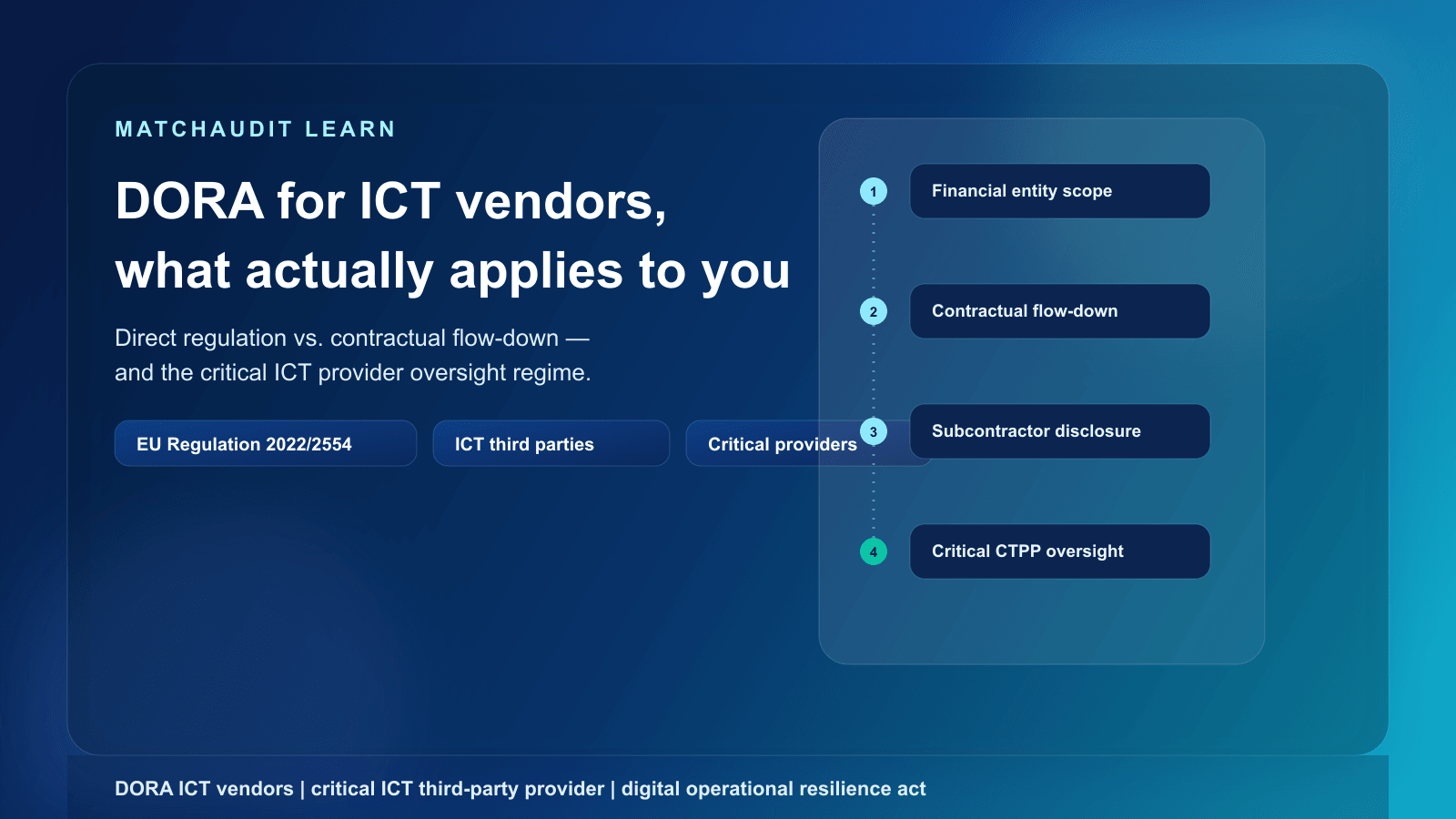
What DORA (EU Regulation 2022/2554) actually requires from ICT vendors selling to EU financial institutions — who is directly regulated, who is a 'critical' ICT third-party provider, and what typically flows down into contracts and due diligence.